
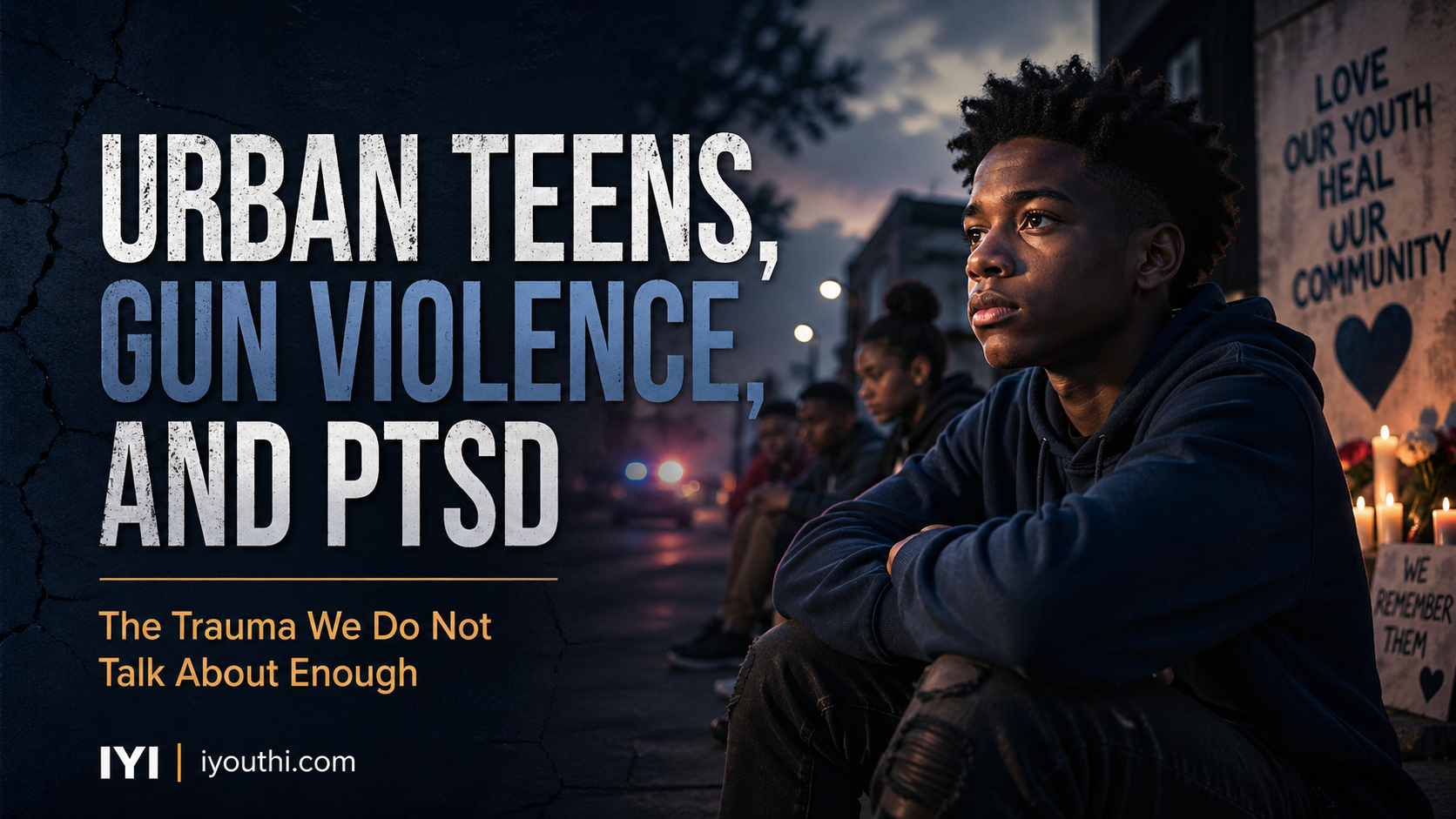
For too many urban teens, gun violence is not just something they hear about on the news. It is something they live around, witness, fear, and carry with them long after the sirens stop.
In Black communities especially, the conversation around gun violence often focuses on crime statistics, arrests, or homicide counts. But not enough attention is given to what repeated exposure does to a young person’s mind. The trauma does not always show up as tears or panic. Sometimes it looks like anger, numbness, distrust, isolation, poor concentration, sleep problems, or always feeling on edge.
That is why this conversation must include PTSD.
PTSD, or post-traumatic stress disorder, can develop after someone experiences or witnesses a traumatic event. The National Institute of Mental Health notes that PTSD can affect people of any age, including children and teens, after they experience or witness violence or other serious trauma.
This matters because exposure to violence among teens is not rare. CDC reporting based on the 2021 Youth Risk Behavior Survey found that 19.9% of high school students reported ever witnessing community violence. The same CDC report says students who witnessed community violence were more likely to report gun carrying, substance use, and suicide risk, and it explicitly notes that repeated exposure to community violence has been associated with poor mental health, including PTSD and major depression.
The burden is not shared equally. CDC says racial and ethnic minority students, including Black students, were more likely than White peers to report witnessing community violence. The report explains that these disparities are tied to structural conditions such as discrimination, concentrated poverty, high-crime environments, and instability.
The firearm data is just as alarming. KFF reports that in 2024, Black youth had the highest firearm death rate among racial and ethnic groups at 10.0 per 100,000, compared with 1.9 per 100,000 for White youth. Black youth also accounted for 46% of all youth firearm deaths while making up only 14% of the U.S. youth population.
Even beyond deaths, the trauma footprint is much wider. KFF reports that over the past decade, nearly 22,000 youth ages 17 and younger died by firearm, and for every firearm fatality there are at least two survivors of firearm injuries. That means a much larger number of young people are living with direct or indirect trauma tied to shootings.
Research on community violence exposure in urban youth helps explain why this matters so much. One review found that over 85% of urban youth report witnessing some form of community violence in their lifetime and almost 70% report direct victimization. Another meta-analysis summarized in recent research found an overall PTSD rate of 15.9% among youth exposed to community violence.
Milwaukee reflects the urgency of this issue. A 2025 Wisconsin Policy Forum report found that from 2018 to 2023, about four-fifths of youth justice referrals involved Black youth and youth with behavioral health issues. The report also found that while some youth gun-violence indicators improved in 2024, referrals tied to several serious offenses remained above pre-pandemic levels, including a rise in firearm-related endangering-safety referrals and intentional homicide referrals compared with 2018.
So when a teen in an urban neighborhood seems checked out, hyper-alert, angry, or disconnected, we should stop asking only, “What is wrong with this kid?” and start asking, “What has this kid seen, survived, or normalized?”
That question changes everything.
Because trauma untreated can become disruption in school, depression, anxiety, substance use, aggression, hopelessness, or deeper involvement with the justice system. But trauma recognized and treated can be interrupted. CDC points to mentoring, street outreach, supportive school environments, and community-level prevention strategies as part of what works to reduce violence and its harms.
This is where organizations like IYI matter.
If we want to help urban Black teens heal and succeed, we cannot only react after violence happens. We need safe spaces, trusted adults, structure, opportunity, emotional support, skill-building, and pathways that help young people believe their future is bigger than what they have witnessed.
Gun violence does not only wound bodies. It wounds sleep, focus, trust, identity, and hope.
And if we are serious about helping our youth, we have to address all of it.
Learn more at iyouthi.com
Support the mission here: https://bit.ly/4sKVAxp