Author: Ted McDaniel

  • The Digital Skills Gap Is the New Opportunity Gap

    The Digital Skills Gap Is the New Opportunity Gap

    The opportunity gap is changing.

    It is no longer only about who has a classroom.
    It is also about who has access to digital skills.
    Who understands technology.
    Who knows how to use AI.
    Who can create, build, research, communicate, and compete in a digital economy.

    For Black urban youth, this matters.

    The world is moving fast. Jobs, business, education, finance, media, transportation, real estate, health care, and entrepreneurship are all being reshaped by technology. Young people who are not exposed early can be left behind before they even get started.

    That is why the digital skills gap is the new opportunity gap.

    The numbers show the shift

    The National Skills Coalition reported that 92% of jobs analyzed require digital skills. The same report also found that about one-third of workers lack the foundational digital skills needed to enter and succeed in many jobs today.

    That means digital skills are no longer optional.

    They are becoming basic survival tools for the modern economy.

    The Pew Research Center also reported that 26% of U.S. teens ages 13 to 17 used ChatGPT for schoolwork in 2024, which was double the share reported in 2023.

    That shows AI is already entering youth education.

    The question is not whether young people will be around AI.

    The question is whether they will be taught how to use it with purpose, discipline, and direction.

    Access is not the same as skill

    Many young people have access to phones.

    But having a phone is not the same as having digital power.

    A teen can scroll all day and still not know how to build a resume.
    They can watch videos all day and still not know how to create a business plan.
    They can use apps every day and still not understand AI, coding, design, data, budgeting, marketing, or digital entrepreneurship.

    That is the difference between consumption and creation.

    Consumption keeps youth reacting.

    Creation helps youth build.

    IYI wants young people to move from users of technology to builders with technology.

    AI education can change the mindset

    AI can help youth learn faster, think deeper, and create more.

    It can help them research careers.
    It can help them practice writing.
    It can help them organize goals.
    It can help them create presentations.
    It can help them understand money concepts.
    It can help them study business ideas.
    It can help them build digital projects.
    It can help them prepare for interviews, school, entrepreneurship, and leadership.

    But AI must be taught the right way.

    Not as a shortcut.
    Not as cheating.
    Not as a replacement for thinking.

    AI should be taught as a tool for learning, creativity, research, problem-solving, and preparation.

    That is where mentorship matters.

    Mentorship gives technology direction

    Technology without guidance can become distraction.

    Mentorship helps turn technology into purpose.

    A mentor can teach a young person how to ask better questions.
    How to check information.
    How to use AI responsibly.
    How to connect digital tools to real goals.
    How to build a project instead of just consuming content.

    At International Youth Initiative, mentorship is part of the solution because young people need more than access.

    They need direction.

    They need adults who can help them understand what these tools mean, how to use them wisely, and how to connect them to their future.

    Digital skills connect to real opportunity

    Digital skills do not stand alone.

    They connect to everything.

    Financial literacy helps youth understand money.
    AI helps youth learn and create.
    Technology helps youth build skills.
    Entrepreneurship helps youth turn ideas into action.
    Market education teaches patience, strategy, and risk management.
    Leadership teaches responsibility and communication.

    Together, these tools help youth prepare for the real world.

    A young person who learns AI can build a project.
    A young person who learns financial literacy can manage money.
    A young person who learns entrepreneurship can create opportunity.
    A young person who learns market education can think strategically.
    A young person with mentorship can stay focused long enough to grow.

    That is how IYI fits in.

    The new gap needs a new response

    If the economy is changing, youth development has to change too.

    It is not enough to tell young people to stay out of trouble.

    We have to give them tools powerful enough to compete with the pressure around them.

    We have to expose them to technology.
    We have to teach AI.
    We have to build digital confidence.
    We have to create safe spaces.
    We have to provide mentors.
    We have to connect learning to real opportunity.

    The digital skills gap is not just a technology issue.

    It is a future issue.

    It is an employment issue.
    It is an education issue.
    It is an income issue.
    It is a confidence issue.
    It is an opportunity issue.

    The IYI mission

    International Youth Initiative exists to help young people build before the world leaves them behind.

    The mission is to expose youth to tools that can change how they see themselves and their future.

    Not just phones.
    Skills.

    Not just apps.
    Creation.

    Not just scrolling.
    Building.

    Not just survival.
    Strategy.

    At IYI, we believe Black urban youth deserve access to the same future-building tools shaping the world around them.

    AI education.
    Financial literacy.
    Digital skills.
    Entrepreneurship.
    Market education.
    Leadership.
    Mentorship.
    Safe spaces.
    Real-world opportunity.

    The numbers show the need.

    The mission is to close the gap.

    One mentor.
    One lesson.
    One digital skill.
    One project.
    One young person at a time.


  • How AI Education Can Help Youth Build Future Power

    How AI Education Can Help Youth Build Future Power

    Technology is changing the world fast.

    The question is whether our youth will only watch it happen — or be prepared to build with it.

    For many Black urban teens, the issue is not a lack of intelligence, creativity, or talent. The issue is exposure. Too many young people are surrounded by technology every day, but they are not always taught how to use it for learning, business, creativity, careers, ownership, or opportunity.

    That is why AI education matters.

    At International Youth Initiative, we believe AI should not just be something young people hear about after the world has already moved ahead. They should be introduced to it early, guided properly, and shown how it can help them build.

    The numbers show the gap

    The Annie E. Casey Foundation reported that roughly 7% to 10% of teens ages 16 to 19 are disconnected from both school and work. These youth face increased risks of long-term economic instability and limited career opportunities.

    That number matters because disconnection can remove structure, purpose, and future planning from a young person’s life.

    The CDC also reported that from 2021 to 2023, the percentage of students who missed school because of safety concerns at school or on the way to school increased from 9% to 13%.

    That means some young people are not only disconnected from opportunity — they may also feel unsafe in the places where they are supposed to grow.

    AI education cannot solve all of that by itself.

    But it can become part of the solution.

    AI can turn curiosity into skill

    Many young people already use phones, apps, videos, games, and social media every day.

    But using technology is not the same as building with technology.

    AI education can help youth understand how to ask better questions, research ideas, create content, organize projects, explore careers, and solve problems.

    A young person can use AI to build a resume.
    Create a business plan.
    Study a career path.
    Design a presentation.
    Practice communication.
    Learn financial concepts.
    Plan a project.
    Turn an idea into action.

    That changes how learning feels.

    It becomes useful.
    It becomes creative.
    It becomes connected to the future.

    From consumers to creators

    Too many young people are trained to consume.

    Scroll.
    Watch.
    React.
    Share.
    Repeat.

    But IYI wants youth to become creators, builders, thinkers, and problem-solvers.

    AI can help a young person see that their ideas have value. It can help them turn thoughts into projects, questions into research, and creativity into skills.

    That kind of exposure can build confidence.

    A young person can begin to think, “Maybe I can create something. Maybe I can build something. Maybe I can compete in the future economy.”

    That mindset shift matters.

    AI needs mentorship

    AI is powerful, but young people still need guidance.

    They need mentors who can teach them how to use AI responsibly. They need adults who can help them understand accuracy, ethics, creativity, discipline, and purpose.

    AI should not replace human support.

    It should strengthen it.

    Mentorship helps youth understand that AI is a tool, not a shortcut. It can help them learn faster, but they still need focus. It can help them create, but they still need discipline. It can help them explore, but they still need direction.

    At IYI, AI education works best when it is connected to mentorship, safe spaces, leadership, and real-world learning.

    How IYI fits in

    International Youth Initiative is focused on helping youth build future power through exposure and preparation.

    AI education connects directly to that mission.

    Financial literacy teaches decision-making.
    Entrepreneurship teaches ownership.
    Technology and AI teach future skills.
    Market education teaches patience, risk, and strategy.
    Leadership teaches responsibility.
    Mentorship teaches youth they do not have to build alone.
    Safe spaces give youth somewhere to learn, practice, and grow.

    These tools work together.

    AI can help youth access information.
    Mentorship can help them use it wisely.
    Financial literacy can help them connect it to real life.
    Entrepreneurship can help them turn ideas into action.
    Leadership can help them use their skills with purpose.

    Future power starts with exposure

    The future should not leave our youth behind.

    If young people are not exposed to AI, technology, financial literacy, entrepreneurship, and leadership, the opportunity gap can grow wider.

    But if they are exposed early, supported properly, and mentored consistently, the same tools changing the world can help them build a future inside it.

    That is the mission.

    Not hype.
    Not shortcuts.
    Not replacing human care.

    Real education.
    Real mentorship.
    Real skills.
    Real opportunity.

    At IYI, we believe AI education can help young people move from distraction to creation, from uncertainty to skill, and from limited exposure to future power.

    The numbers show the need.

    The mission is to build the bridge.

    One lesson.
    One mentor.
    One safe space.
    One tool.
    One young person at a time.


  • How AI Can Help Curb PTSD and Trauma in Black Urban Youth

    How AI Can Help Curb PTSD and Trauma in Black Urban Youth

    Trauma does not always look like trauma.

    Sometimes it looks like anger.
    Sometimes it looks like silence.
    Sometimes it looks like poor focus.
    Sometimes it looks like skipping school.
    Sometimes it looks like emotional shutdown.
    Sometimes it looks like a young person always ready to react.

    For many Black urban youth, trauma can come from what they have seen, what they have lost, what they have survived, and what they are still carrying.

    That is why PTSD and trauma cannot be ignored.

    Post-traumatic stress disorder can happen after a person experiences or witnesses something frightening, dangerous, or deeply painful. For young people, trauma can affect sleep, learning, emotional control, relationships, decision-making, and how safe they feel in the world.

    The numbers show the pressure is real.

    The CDC reported that in 2023, many high school students were still struggling with mental health challenges, including persistent sadness or hopelessness, poor mental health, suicidal thoughts, and suicide attempts.

    The National Center for PTSD has also reported that among children and teens who experience trauma, some develop PTSD, with rates varying by gender and type of trauma.

    These numbers matter because they remind us that many youth are carrying battles people cannot always see.

    Trauma can shape reaction

    A young person living with unresolved trauma may not always know how to explain what they feel.

    They may react fast.
    They may distrust adults.
    They may struggle to focus.
    They may feel unsafe even when no danger is present.
    They may carry anger that is really pain.
    They may avoid talking because silence feels safer.

    When trauma is not addressed, it can affect school, relationships, behavior, confidence, and future planning.

    That does not mean the young person is broken.

    It means they need support.

    At International Youth Initiative, we believe youth need safe spaces, mentors, tools, and real pathways that help them process pressure before it turns into destructive choices.

    How AI can help

    AI cannot replace therapists, parents, mentors, or community support.

    But AI can be a tool.

    When used responsibly, AI can help identify patterns, organize resources, support early screening, and connect young people to help faster.

    AI tools can help youth and mentors recognize signs of stress.
    AI can help organize mental health resources.
    AI can help create reflection prompts and journaling exercises.
    AI can help personalize learning and coping strategies.
    AI can help track progress over time.
    AI can help connect youth to the right support when warning signs appear.

    The power is not in AI replacing people.

    The power is in AI helping people respond earlier.

    Early support matters

    Trauma becomes more dangerous when it stays hidden.

    If a young person is struggling, early support can make a difference.

    A mentor may notice changes in behavior.
    A teacher may notice withdrawal.
    A parent may notice anger or sleep problems.
    A program may notice missed sessions or emotional changes.

    AI can help organize these signals, but human care must lead the response.

    The goal is not to label young people.

    The goal is to support them.

    The goal is not surveillance.

    The goal is connection.

    At IYI, AI should be used as a bridge to care, not as a replacement for care.

    AI and mentorship together

    The strongest solution is not technology alone.

    It is technology plus mentorship.

    A young person may use an AI tool to reflect on stress, but they still need a trusted adult to listen. They may use a digital resource to learn about trauma, but they still need real support to process what they are carrying.

    Mentorship gives youth what AI cannot.

    Trust.
    Presence.
    Accountability.
    Compassion.
    Human understanding.
    Someone who can look them in the eyes and say, “You are not alone.”

    AI can help identify needs.

    Mentorship can help meet them.

    IYI’s role in healing

    International Youth Initiative can help curb trauma and PTSD-related outcomes by creating spaces where youth are not judged by their pain.

    IYI can help youth learn emotional control through mentorship.
    IYI can help youth build confidence through leadership.
    IYI can help youth reduce hopelessness through opportunity.
    IYI can help youth process pressure through safe spaces.
    IYI can help youth use AI and technology as tools for learning, reflection, and support.

    This work matters because healing is not only about therapy.

    Healing is also about purpose.
    Healing is about safety.
    Healing is about structure.
    Healing is about connection.
    Healing is about having something positive to build.

    When youth are exposed to financial literacy, technology, AI, market education, entrepreneurship, leadership, and mentorship, they begin to see a future beyond pain.

    That future can become part of the healing process.

    From trauma to tools

    PTSD and trauma can make a young person feel trapped in survival mode.

    But the right tools can help them move forward.

    AI can help organize information.
    Mentorship can help build trust.
    Safe spaces can help create stability.
    Financial literacy can help reduce money stress.
    Market education can teach patience and emotional control.
    Technology can open new doors.
    Leadership can help youth see themselves with value.

    That is how IYI fits in.

    Not by pretending AI solves everything.

    Not by ignoring the deep pain youth carry.

    But by combining modern tools with human support, community care, and real opportunity.

    The mission is prevention and healing

    The numbers behind PTSD and youth mental health are serious.

    But they should not lead us to hopelessness.

    They should lead us to action.

    Reach youth earlier.
    Listen more closely.
    Create safer spaces.
    Use technology responsibly.
    Train mentors.
    Build pathways.
    Connect youth to help.
    Give them tools before trauma defines them.

    At IYI, we believe young people are more than what they have survived.

    They are thinkers.
    They are builders.
    They are leaders in development.
    They are futures worth protecting.

    AI can help us see the warning signs sooner.

    Mentorship can help us respond with care.

    Opportunity can help youth believe healing is possible.

    That is how we begin to change the numbers.

    One young person.
    One mentor.
    One safe space.
    One tool.
    One future at a time.


  • Teach the Mind Before the World Teaches Survival

    Teach the Mind Before the World Teaches Survival

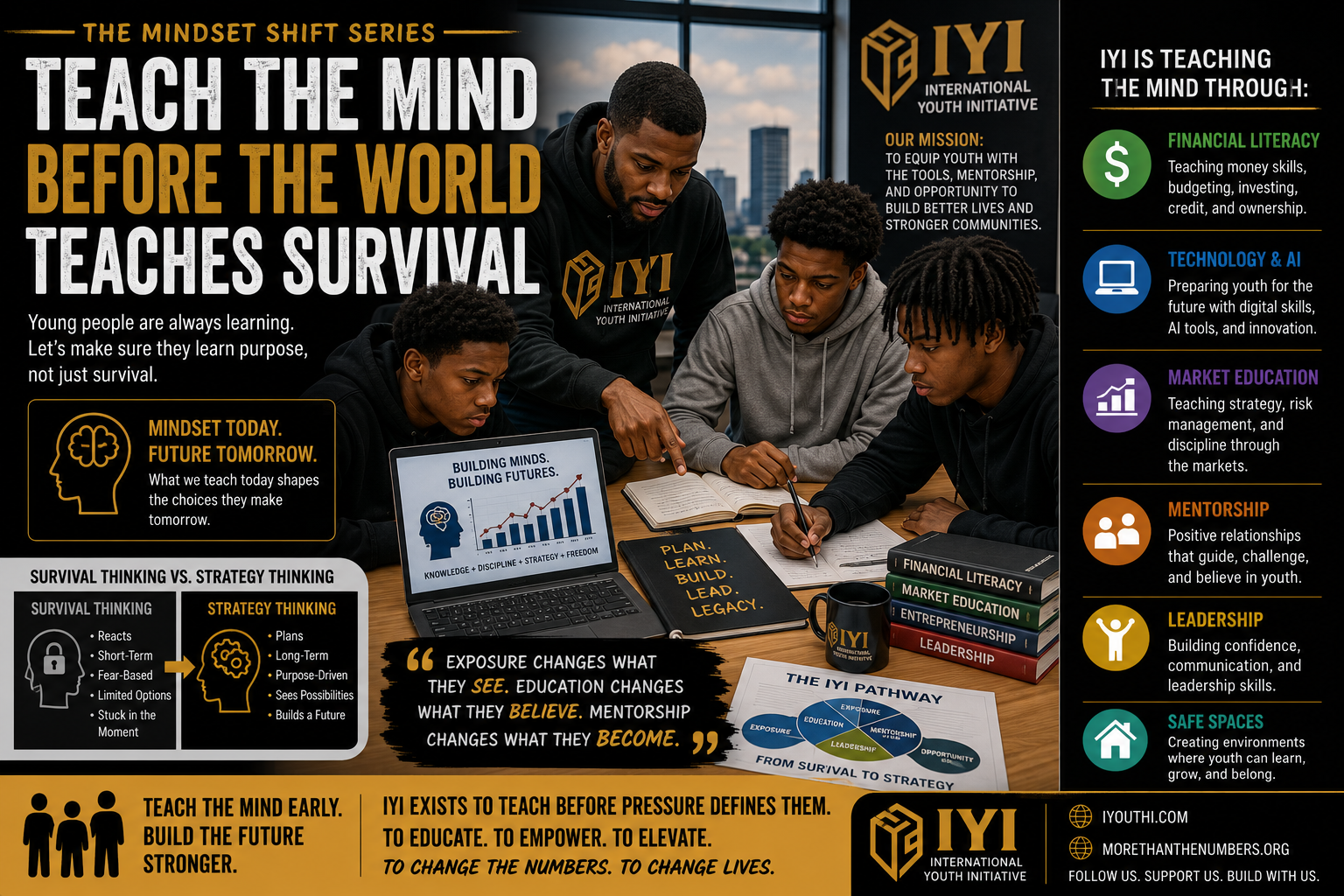
    Young people are learning every day.

    They learn from what they see.
    They learn from what they hear.
    They learn from what they survive.
    They learn from the people around them.
    They learn from the opportunities they have — and from the opportunities they never receive.

    That is why exposure matters.

    If a young person is not taught purpose, discipline, patience, leadership, ownership, and future thinking, the world will still teach them something.

    It may teach survival.
    It may teach reaction.
    It may teach fear.
    It may teach distrust.
    It may teach fast decisions.
    It may teach pressure before purpose.

    At International Youth Initiative, we believe we have to reach the mind before survival becomes the only mindset.

    The mind needs direction

    A young person without direction can be pulled by whatever is closest.

    Street pressure.
    Negative influence.
    Hopelessness.
    Anger.
    Quick money.
    Fear of being left behind.

    But when a young person is given direction, something begins to shift.

    They start thinking differently.
    They start asking better questions.
    They start seeing choices instead of only pressure.
    They start understanding that their future can be built, not just survived.

    That is the mindset shift.

    IYI believes young people need more than motivation. They need structure. They need tools. They need mentors. They need spaces where their minds can grow.

    Survival thinking can become a trap

    Survival thinking is understandable when a young person has been surrounded by pressure.

    If the environment is stressful, the mind adapts.
    If the future feels unclear, the moment becomes everything.
    If opportunity feels far away, short-term decisions can feel normal.

    But survival thinking can become a trap when it is never challenged by something better.

    A young person may begin to believe that life is only about getting through today. They may stop imagining tomorrow. They may stop planning. They may stop seeing their own potential.

    That is why IYI focuses on exposure.

    Exposure helps youth see beyond the moment.

    Financial literacy teaches control

    Financial literacy is one way to teach the mind.

    When young people learn about money, budgeting, saving, credit, investing, ownership, and long-term planning, they begin to understand that choices matter.

    Money education is not just about dollars.

    It is about discipline.
    It is about decision-making.
    It is about patience.
    It is about responsibility.
    It is about learning how to think before moving.

    That kind of thinking can affect every part of life.

    Technology and AI teach possibility

    Technology is changing the world fast.

    Young people should not be left outside of that future. They need to understand digital tools, AI, creative platforms, and new career pathways.

    At IYI, technology is not just something youth use.

    It is something they can learn, build with, create with, and grow through.

    AI can help youth explore ideas.
    Digital tools can help youth create projects.
    Technology can open doors to careers, business, education, and innovation.

    When youth are exposed to technology, they begin to see that the future is not only something happening to them.

    It is something they can participate in.

    Market education teaches strategy

    Stock market, options market, and currency market education can also teach the mind.

    Not as gambling.
    Not as quick money.
    Not as hype.

    But as strategy.

    Market education teaches patience, research, timing, risk management, emotional control, and discipline.

    A young person who learns to study before making a move can carry that lesson into life. A young person who learns to manage risk can begin thinking differently about choices, conflict, money, and opportunity.

    That is why market education matters.

    It helps move youth from reaction to strategy.

    Mentorship teaches belief

    Young people need people who believe in them before they fully believe in themselves.

    Mentorship gives youth guidance.
    Mentorship gives youth accountability.
    Mentorship gives youth encouragement.
    Mentorship gives youth someone to talk to before pressure wins.

    At IYI, mentorship is not about judging young people.

    It is about helping them see what is still possible.

    A mentor can help a young person understand that they are more than a mistake, more than a statistic, more than a struggle, and more than what their environment may have told them.

    That belief can become a turning point.

    Teach before pressure defines them

    The goal is to reach youth early.

    Before survival becomes identity.
    Before pressure becomes direction.
    Before trauma becomes silence.
    Before mistakes become permanent.
    Before potential gets overlooked.

    IYI exists because young people need to be taught before the world miseducates them.

    They need safe spaces.
    They need mentors.
    They need real-world skills.
    They need exposure to money, markets, technology, business, leadership, and opportunity.

    They need to know that their mind is valuable.

    Because once a young person begins to think differently, they can begin to move differently.

    The IYI mission

    International Youth Initiative is working to help young people move from survival thinking to strategy thinking.

    Not by ignoring the pressure they face, but by giving them tools to rise above it.

    Financial literacy.
    Entrepreneurship.
    Technology and AI.
    Market education.
    Leadership.
    Mentorship.
    Safe spaces.
    Real-world opportunity.

    These are tools that can help shape stronger minds and stronger futures.

    The world is already teaching our youth every day.

    The question is: what are we teaching them first?

    At IYI, the answer is purpose, discipline, knowledge, leadership, and opportunity.

    Teach the mind early.

    Build the future stronger.


  • How IYI Can Help Change the Numbers

    How IYI Can Help Change the Numbers

    Negative youth statistics do not have to become permanent outcomes.

    Behind every number is a young person.
    Behind every young person is a story.
    Behind every story is potential that still deserves to be protected, developed, and invested in.

    Too often, Black urban teens are talked about through negative numbers connected to violence, unemployment, school disconnection, mental health, poverty, and lack of opportunity.

    Those numbers are real.

    But they are not the whole story.

    At International Youth Initiative, we believe statistics should not be used to label young people. They should be used to show where support is needed most.

    The goal is not just to talk about the numbers.

    The goal is to help change them.

    The numbers show the pressure

    Many young people are carrying pressure that adults may not always see.

    Some are dealing with trauma.
    Some are dealing with grief.
    Some are dealing with stress at home.
    Some are trying to survive unsafe environments.
    Some are disconnected from school, work, mentorship, or opportunity.

    When that pressure is not supported, it can show up in the statistics.

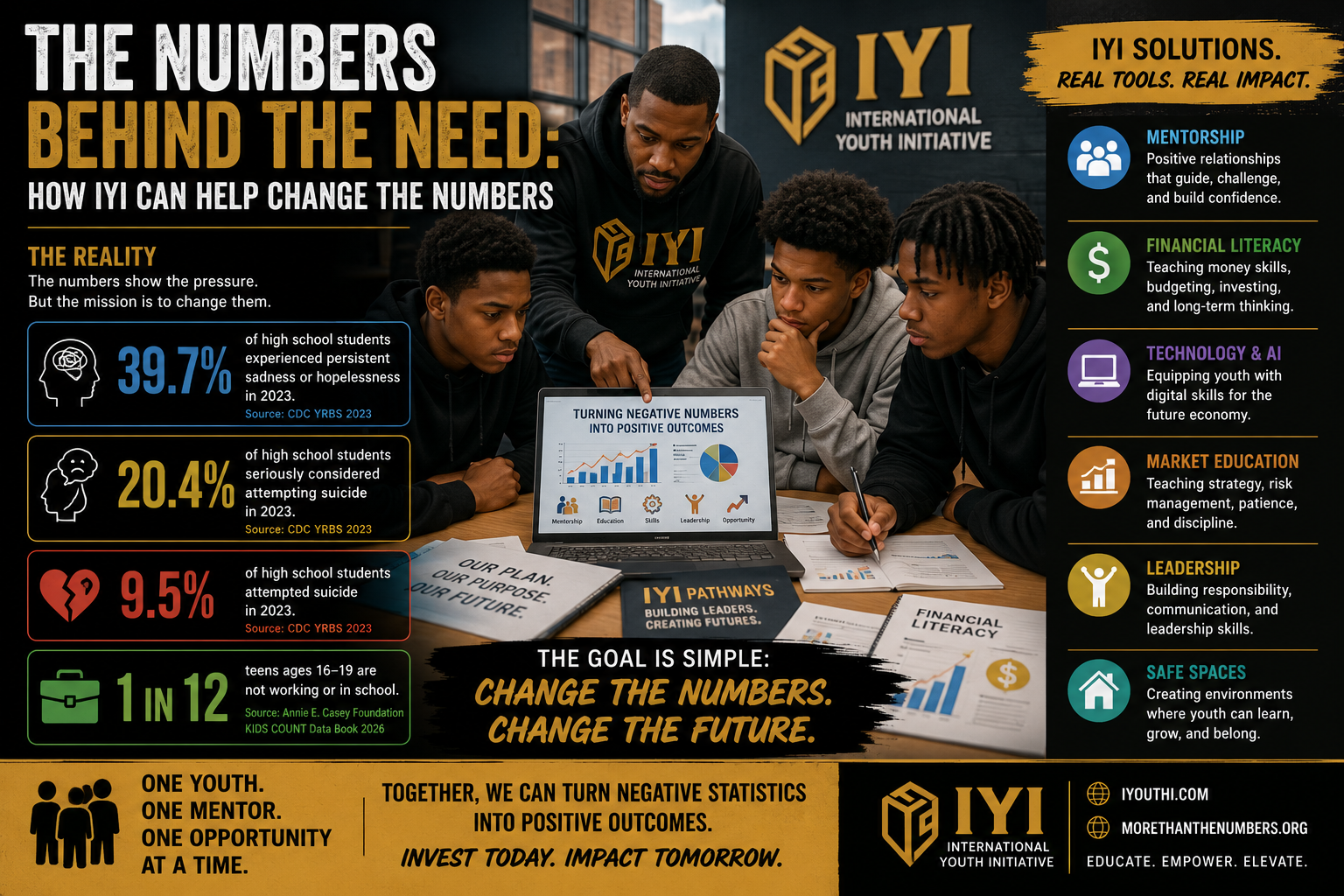
    The CDC reported that in 2023, 39.7% of high school students experienced persistent sadness or hopelessness, 20.4% seriously considered attempting suicide, and 9.5% attempted suicide.

    The Annie E. Casey Foundation reported that about 1 in 12 teens ages 16 to 19 are not working or in school.

    These numbers show more than problems.

    They show the need for prevention, connection, mentorship, safe spaces, and real opportunity.

    Negative numbers need real solutions

    A negative statistic is not just a data point.

    It is a warning sign.

    It tells us something is missing.

    Maybe a young person needs a mentor.
    Maybe they need a safe place to go.
    Maybe they need financial education.
    Maybe they need career exposure.
    Maybe they need technology skills.
    Maybe they need leadership development.
    Maybe they need someone to help them see a future bigger than survival.

    That is where IYI fits in.

    IYI is built around the belief that young people need more than motivation. They need tools. They need structure. They need exposure. They need adults who show up consistently.

    Mentorship can change direction

    Mentorship can help interrupt negative outcomes before they become permanent.

    A mentor can listen before a young person shuts down.
    A mentor can guide before a bad decision is made.
    A mentor can challenge before potential gets wasted.
    A mentor can remind a young person that their future still matters.

    Many youth do not need to be judged.

    They need to be reached.

    At IYI, mentorship is not just encouragement. It is connection, accountability, guidance, and belief.

    That kind of support can help a young person move differently.

    Financial literacy can change decision-making

    Money pressure is real in many urban communities.

    When young people are not taught about budgeting, saving, credit, debt, investing, ownership, or long-term planning, they may be more vulnerable to quick-money thinking and short-term decisions.

    Financial literacy gives youth language.

    It helps them understand choices.
    It helps them think long term.
    It helps them respect discipline.
    It helps them see money as something to manage with purpose.

    At IYI, financial literacy is not just about dollars.

    It is about decision-making.

    Technology and AI can open new doors

    The future economy is moving fast.

    Young people need exposure to technology, AI, digital tools, and future career pathways. If they are not introduced to these tools early, they can be left behind before they even get started.

    IYI wants youth to be more than consumers of technology.

    We want them to become users, builders, creators, and thinkers.

    Technology can help youth learn faster.
    AI can help youth explore ideas.
    Digital skills can help youth compete.
    Creative tools can help youth build projects, businesses, and new pathways.

    Exposure can change what a young person believes is possible.

    Market education can teach strategy

    Stock market, options market, and currency market education are bigger than charts.

    They teach patience.
    They teach risk management.
    They teach emotional control.
    They teach research.
    They teach timing.
    They teach discipline.

    Those lessons can carry into life.

    A young person who learns to study before moving can apply that same lesson to real decisions. A young person who learns to manage risk can begin thinking differently about choices, conflict, money, and opportunity.

    Market education helps move youth from reaction to strategy.

    Safe spaces can create stability

    Young people need places where they can breathe, learn, ask questions, and grow without being judged.

    A safe space gives youth structure.

    It gives them somewhere to go.
    It gives them something to do.
    It gives them people to learn from.
    It gives them a place where purpose can grow.

    IYI’s vision is to help create spaces where young people are not just kept busy — they are being built.

    Built with knowledge.
    Built with discipline.
    Built with mentorship.
    Built with leadership.
    Built with opportunity.

    The mission is to change outcomes

    The numbers behind the need are serious.

    But the answer cannot be hopelessness.

    The answer has to be investment.

    Invest in youth early.
    Invest in mentorship.
    Invest in safe spaces.
    Invest in financial literacy.
    Invest in technology and AI.
    Invest in leadership.
    Invest in real pathways.

    When young people receive the right support, negative statistics do not have to define their future.

    A disconnected youth can reconnect.
    A struggling student can find direction.
    A teen under pressure can find purpose.
    A young person surrounded by risk can be exposed to opportunity.

    That is the mission.

    IYI exists because the numbers are real.

    But so is the potential.

    The goal is to help turn negative statistics into positive outcomes — one young person, one mentor, one lesson, one opportunity at a time.


  • Purpose Before Pressure

    Purpose Before Pressure

    Pressure comes early for many young people.

    Pressure to fit in.
    Pressure to survive.
    Pressure to prove themselves.
    Pressure to make money.
    Pressure to react.
    Pressure to move fast before they have been taught how to move wisely.

    For many Black urban teens, pressure can become louder than purpose.

    That is why purpose matters.

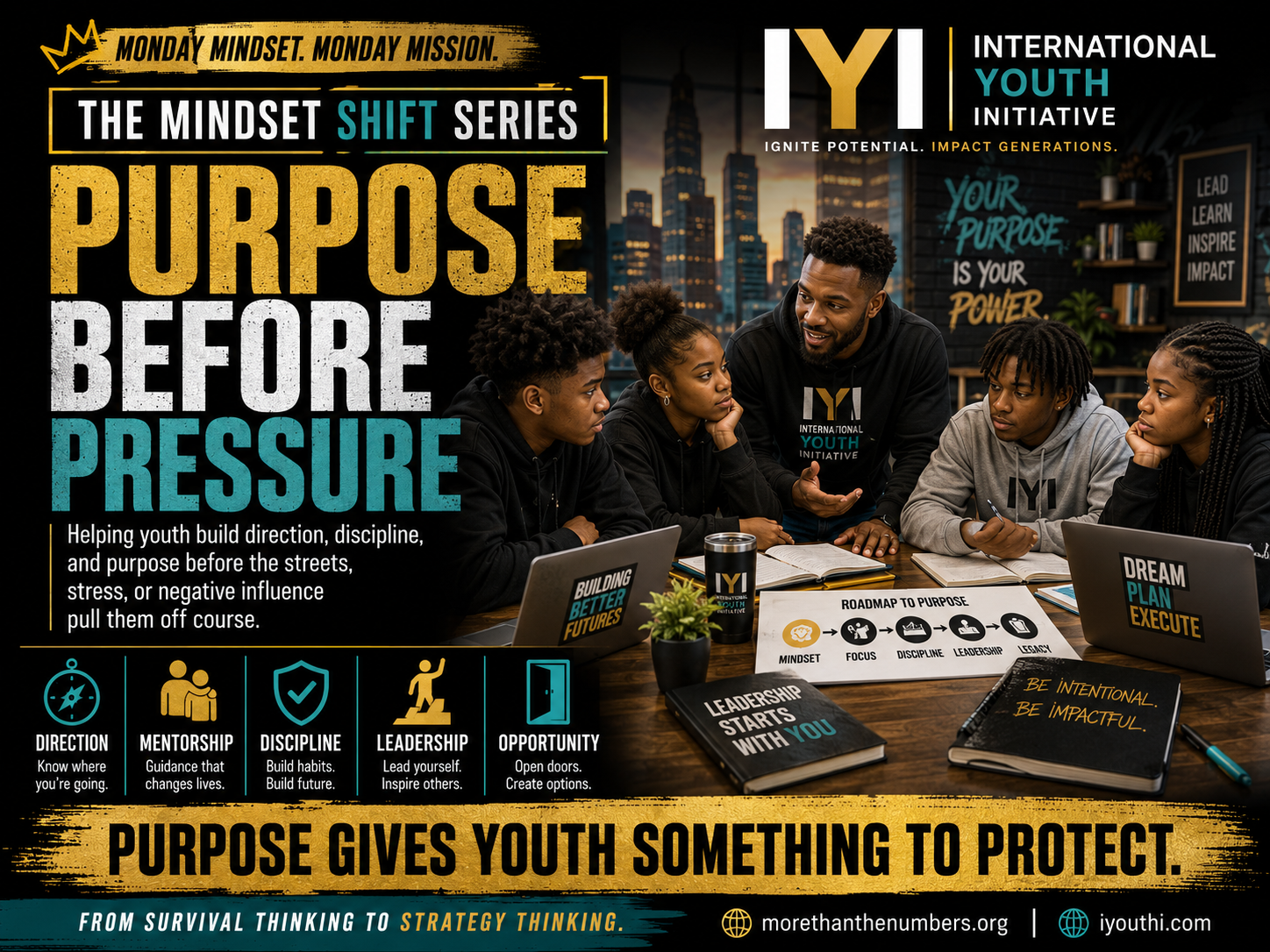
    Purpose gives a young person something to think about before they react. It gives them a reason to pause. It gives them a reason to protect their future. It gives them something stronger to move toward.

    At International Youth Initiative, we believe young people need purpose before pressure pulls them in the wrong direction.

    Purpose creates direction

    A young person without direction can be pulled by whatever is closest.

    The streets.
    Drama.
    Anger.
    Fear.
    Hopelessness.
    Fast money.
    Negative influence.

    But when a young person begins to see a future, their decisions can start to change.

    Purpose does not mean they have everything figured out. It means they have a reason to keep building. It means they can begin asking better questions.

    Who am I becoming?
    What am I learning?
    What am I building?
    Who is guiding me?
    What choices protect my future?

    Those questions matter.

    They help move a young person from survival thinking to strategy thinking.

    Exposure helps build purpose

    Many youth are not lacking talent. They are lacking exposure.

    They may not have been shown how money works.
    They may not have been shown how business works.
    They may not have been introduced to technology, AI, markets, leadership, or ownership.

    When exposure is missing, opportunity can feel far away.

    IYI works to change that.

    Through financial literacy, entrepreneurship, technology, AI, market education, leadership, and mentorship, young people can begin to see more than what is directly around them.

    Exposure opens the mind.

    A teen who learns financial literacy can begin thinking about choices.
    A teen who learns entrepreneurship can begin thinking about ownership.
    A teen who learns technology can begin thinking about the future economy.
    A teen who learns market education can begin thinking about patience, risk, and strategy.
    A teen who receives mentorship can begin believing they are not alone.

    That kind of exposure can help purpose grow.

    Mentorship makes purpose stronger

    Purpose is hard to build alone.

    Young people need adults who show up, listen, challenge them, and guide them without giving up on them.

    Mentorship gives youth support when pressure is heavy. It gives them someone to talk to before a bad decision becomes permanent. It gives them someone who can help them see the leader inside themselves before the world labels them as lost.

    At IYI, mentorship is not just advice.

    It is connection.
    It is accountability.
    It is guidance.
    It is encouragement.
    It is someone saying, “Your future still matters.”

    That message can change the way a young person sees themselves.

    Discipline protects purpose

    Purpose needs discipline.

    It is not enough to dream. Young people also need structure, habits, patience, and focus.

    That is why IYI connects purpose to real-world learning.

    Financial literacy teaches discipline with money.
    Market education teaches discipline with timing and risk.
    Technology teaches discipline with learning and practice.
    Entrepreneurship teaches discipline with ideas and execution.
    Leadership teaches discipline with responsibility.

    These lessons help youth understand that purpose is not just something they feel.

    It is something they build.

    Day by day.
    Choice by choice.
    Lesson by lesson.
    Mentor by mentor.

    Pressure does not have to win

    The pressure is real.

    But pressure does not have to define a young person’s future.

    With the right support, pressure can be redirected into focus.
    Pain can be redirected into purpose.
    Energy can be redirected into discipline.
    Talent can be redirected into opportunity.

    That is the mindset shift.

    IYI believes young people deserve more than survival. They deserve exposure, safe spaces, mentorship, real-world skills, and the chance to build something meaningful.

    Purpose before pressure means reaching youth early.

    Before the streets become the loudest voice.
    Before trauma becomes identity.
    Before mistakes become permanent.
    Before potential gets overlooked.

    It means helping young people see themselves as builders, leaders, thinkers, creators, and future owners.

    The IYI mission

    International Youth Initiative is working to create pathways where young people can grow with direction.

    Not just programs.
    Pathways.

    Not just motivation.
    Mentorship.

    Not just talk.
    Tools.

    Financial literacy.
    Entrepreneurship.
    Technology and AI.
    Market education.
    Leadership.
    Safe spaces.
    Real-world opportunity.

    These are the tools that can help young people build purpose strong enough to stand against pressure.

    Because when a young person has purpose, they have something to protect.

    Their mind.
    Their future.
    Their choices.
    Their community.
    Their life.

    The pressure is real.

    But purpose can be stronger.


  • When Youth Disconnect, Opportunity Must Reconnect Them

    When Youth Disconnect, Opportunity Must Reconnect Them

    Behind every statistic is a young person who still needs connection.

    Connection to school.
    Connection to work.
    Connection to mentorship.
    Connection to purpose.
    Connection to opportunity.

    When young people become disconnected, the risk grows. Not because they lack value, intelligence, or potential — but because disconnection can remove structure, guidance, and hope from their daily life.

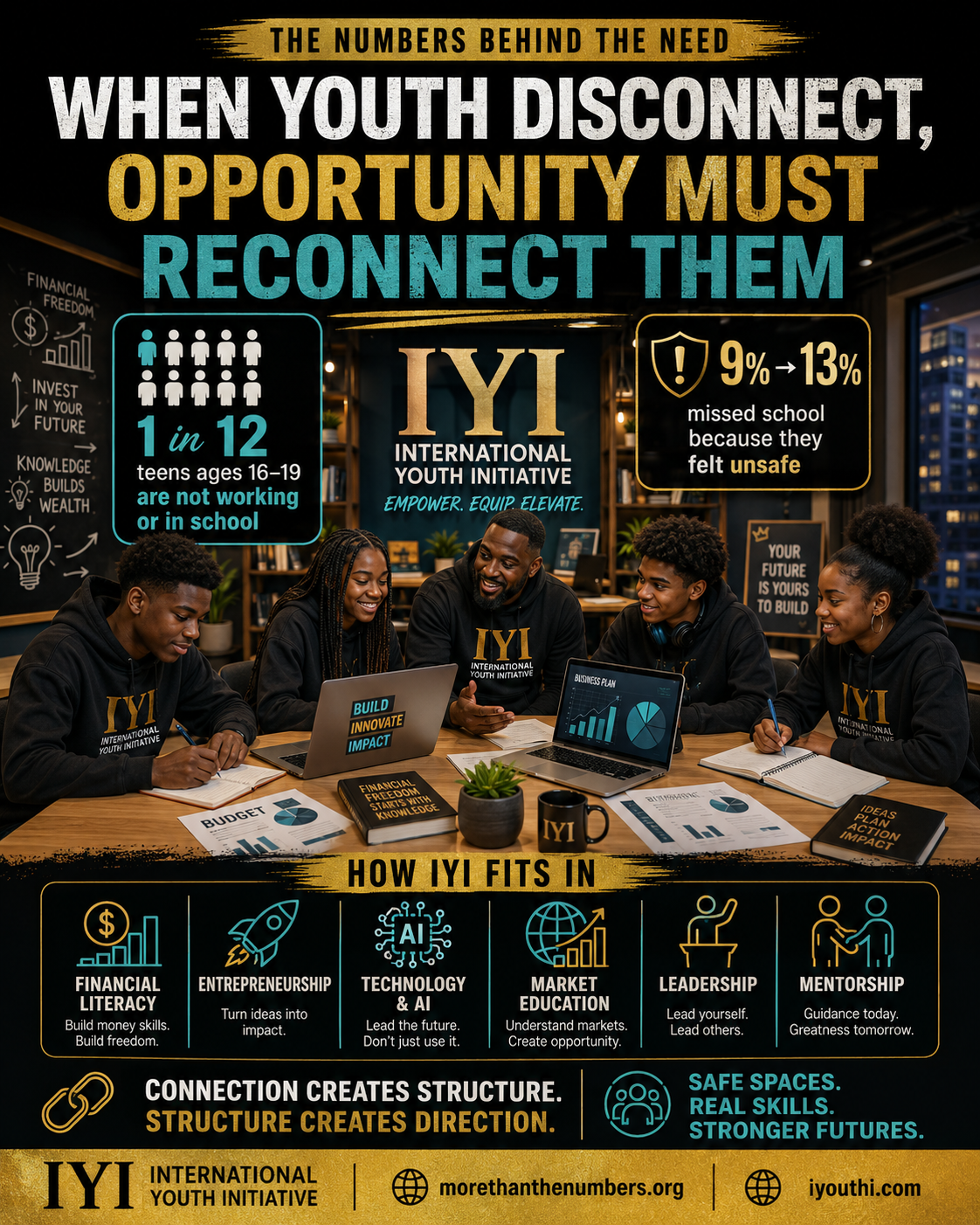
    The Annie E. Casey Foundation reported that about 1 in 12 teens ages 16 to 19 are not working or in school. That number matters because young people without school, work, mentorship, or structure can become more vulnerable to stress, street pressure, frustration, and hopelessness.

    But disconnection is not the end of the story.

    It is a signal.

    It tells us that young people need pathways that feel real. They need spaces where learning connects to life. They need adults who do more than judge them — adults who help them build.

    At International Youth Initiative, we believe reconnection starts with exposure.

    Many youth are not lacking ability. They are lacking access to the right information, the right tools, the right mentors, and the right environments.

    That is why IYI focuses on financial literacy, entrepreneurship, technology, AI, market education, leadership, and mentorship.

    These are not random topics.

    They are tools for reconnection.

    Financial literacy can reconnect youth to decision-making.
    Entrepreneurship can reconnect youth to ownership.
    Technology and AI can reconnect youth to the future economy.
    Market education can reconnect youth to patience, discipline, risk management, and strategy.
    Leadership can reconnect youth to responsibility and purpose.
    Mentorship can reconnect youth to guidance and belief.

    When a young person sees a new path, they can begin to think differently.

    Instead of asking, “What do I do today?”
    They can begin asking, “What am I building for tomorrow?”

    That shift matters.

    The CDC has also reported that student safety concerns are rising. From 2021 to 2023, the percentage of students who missed school because they felt unsafe at school or on the way to school increased from 9% to 13%.

    That means some youth are not only disconnected from opportunity — they may also feel unsafe in places that are supposed to help them grow.

    That is why safe spaces matter.

    A safe space is more than a building. It is a place where young people can breathe, think, ask questions, learn skills, and connect with mentors who see their potential.

    At IYI, we believe youth need spaces where pressure is not the loudest voice in the room.

    They need spaces where they can learn money skills.
    They need spaces where they can explore business ideas.
    They need spaces where they can understand technology.
    They need spaces where they can study markets.
    They need spaces where they can build discipline.
    They need spaces where they can see themselves as leaders.

    Because when youth are connected, they have a better chance to grow.

    Connection can create structure.
    Structure can create discipline.
    Discipline can create direction.
    Direction can create opportunity.

    The goal is not just to talk about disconnected youth.

    The goal is to reconnect them.

    Reconnect them to learning.
    Reconnect them to purpose.
    Reconnect them to mentors.
    Reconnect them to real-world skills.
    Reconnect them to futures they may not have seen yet.

    At IYI, we believe every young person deserves the chance to be more than a statistic.

    They deserve to be seen.
    They deserve to be taught.
    They deserve to be challenged.
    They deserve to be invested in.

    The numbers show the need.

    But the mission is to build the solution.

    One mentor.
    One lesson.
    One safe space.
    One opportunity.
    One young person at a time.

  • Why Safe Spaces Matter for Black Urban Teens

    Why Safe Spaces Matter for Black Urban Teens

    Black urban teens in a safe community learning space with mentors, laptops, charts, and leadership symbols, representing safety, purpose, mentorship, and opportunity through IYI.


    Behind every statistic is a young person looking for somewhere safe to grow.

    A place to think.
    A place to learn.
    A place to ask questions.
    A place to be seen.
    A place where pressure does not have to be the loudest voice in the room.

    For many Black urban teens, safe spaces are not just nice to have. They are necessary.

    A safe space can be the difference between reaction and reflection. It can be the difference between isolation and mentorship. It can be the difference between street pressure and purpose.

    At International Youth Initiative, we believe young people need more than warnings about what not to do. They need places where they can build what they can become.

    Safe spaces create structure

    Many young people are surrounded by pressure every day.

    School pressure.
    Family pressure.
    Street pressure.
    Money pressure.
    Emotional pressure.

    When there is no safe place to process that pressure, youth may carry it alone. And when pressure builds without guidance, it can turn into anger, disconnection, or poor decisions.

    Safe spaces create structure.

    They give youth somewhere to go, something to learn, and someone to connect with. They help young people slow down, think, and make better decisions.

    Structure matters because young people need consistency. They need adults who show up. They need programs that challenge them. They need environments that help them see a future beyond survival.

    Safe spaces support mental health

    Youth mental health cannot be separated from environment.

    A young person who feels unsafe may struggle to focus. A young person who feels unseen may stop asking for help. A young person carrying trauma may need more than advice — they may need connection, trust, and purpose.

    Safe spaces can help create that connection.

    They give youth room to breathe.
    Room to talk.
    Room to learn.
    Room to be guided instead of judged.

    At IYI, we believe mentorship is part of prevention. When young people have trusted adults and positive environments, they are less likely to feel like they have to figure everything out alone.

    Safe spaces build opportunity

    A safe space should not only protect young people from harm.

    It should expose them to opportunity.

    That means financial literacy.
    Entrepreneurship.
    Technology and AI.
    Market education.
    Leadership.
    Mentorship.
    Real-world skills.

    These are the kinds of tools that help youth move from survival thinking to strategy thinking.

    When young people are introduced to money, business, technology, markets, and leadership, they begin to see themselves differently. They begin to understand that their mind is an asset. They begin to see that opportunity is something they can prepare for.

    That is why safe spaces matter.

    They are not just places to sit.

    They are places to build.

    The streets already offer a classroom

    The streets teach lessons too.

    They teach reaction.
    They teach survival.
    They teach distrust.
    They teach fast decisions.
    They teach risk without guidance.

    That is why communities need spaces that teach something different.

    Patience.
    Discipline.
    Focus.
    Ownership.
    Leadership.
    Purpose.

    If young people are not given positive spaces to learn and grow, negative environments will compete for their attention.

    IYI wants to help create spaces where youth can gather around purpose instead of pressure.

    Safe spaces help change the conversation

    Too often, Black urban teens are discussed through labels.

    At-risk.
    Troubled.
    Disconnected.
    Lost.
    A statistic.

    But a safe space allows young people to be seen differently.

    Not as problems to manage, but as minds to develop.

    When youth are placed in environments where they are respected, challenged, and supported, they can begin to show parts of themselves that the world may not always see.

    Their intelligence.
    Their creativity.
    Their leadership.
    Their discipline.
    Their potential.

    That is the power of the right environment.

    The IYI solution

    International Youth Initiative believes safe spaces should connect protection with preparation.

    Youth need somewhere safe to go, but they also need something meaningful to do.

    That is why IYI focuses on financial literacy, entrepreneurship, technology, AI, market education, leadership, mentorship, and real-world opportunity.

    These tools help young people think bigger, move smarter, and build stronger futures.

    A safe space can help a young person pause before reacting.
    A mentor can help them see another option.
    A lesson can give them new language.
    An opportunity can give them new direction.

    That is how change begins.

    One room.
    One mentor.
    One lesson.
    One young person.
    One future at a time.

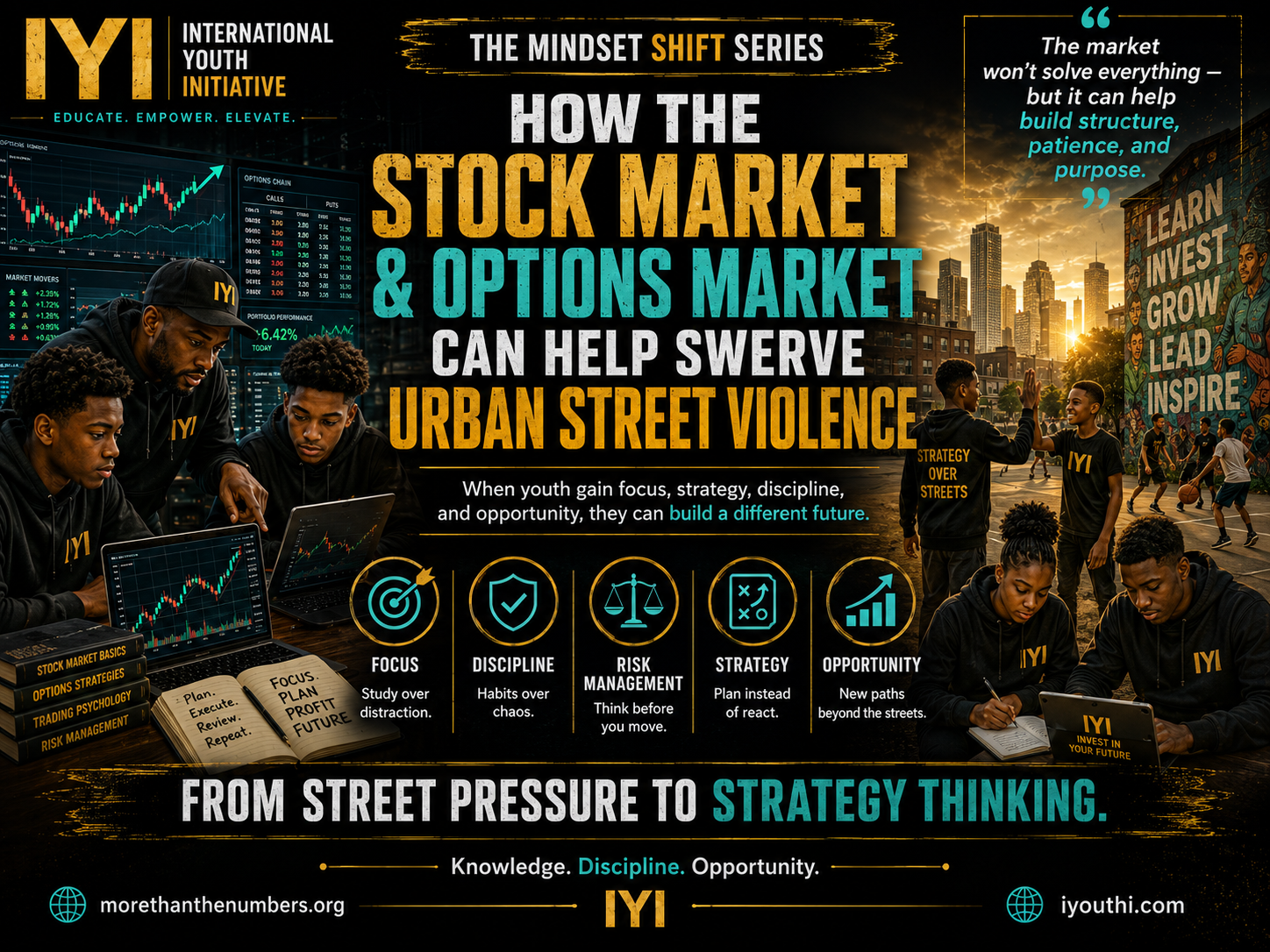
  • How the Stock Market and Options Market Can Help Swerve Urban Street Violence
Slug

    How the Stock Market and Options Market Can Help Swerve Urban Street Violence Slug

    Street violence does not come from nowhere.

    It often grows from pressure — poverty, trauma, anger, limited options, and the feeling that there is no better path. Too many young people are forced to react before they are ever taught how to plan.

    At International Youth Initiative, we believe youth need more than warnings. They need alternatives. They need exposure. They need real tools that can help them think differently.

    That is where stock market and options market education can play a role.

    The market will not solve violence by itself. It does not replace mentors, family, mental health support, jobs, safe spaces, or community investment. But it can introduce something powerful: structure.

    Market education teaches young people to slow down, study, wait, plan, and understand risk before making a move.

    Those lessons are bigger than trading.

    A stock chart can teach focus.
    An options contract can teach risk.
    A trading plan can teach discipline.
    A loss can teach review.
    Waiting for the right setup can teach patience.

    In the streets, reacting too fast can change a life. In the markets, reacting too fast can cost money. Both teach an important truth: decisions have consequences.

    At IYI, we do not teach markets as gambling or quick money. We teach them as a mindset tool. The goal is not to chase fast profits. The goal is to build focus, discipline, patience, and strategy.

    For urban youth carrying pressure, those lessons matter.

    Instead of being pulled into conflict, they can be pulled into learning.
    Instead of chasing street status, they can chase knowledge.
    Instead of moving off emotion, they can learn to move with a plan.

    That is the mindset shift.

    The stock market helps youth understand companies, ownership, money movement, and long-term thinking. The options market helps teach timing, probability, discipline, and risk management. Together, they can expose young people to a world bigger than survival.

    But mentorship is key.

    Young people need guidance to understand the difference between investing, trading, and gambling. They need mentors who can teach emotional control, patience, and responsibility. They need someone to help connect the lesson on the screen to the decisions they face in real life.

    This is bigger than charts.

    When a young person learns to study instead of react, that is growth.
    When they learn to wait instead of chase, that is discipline.
    When they learn to manage risk, that is wisdom.
    When they learn to think ahead, that is leadership.

    Street violence is serious. But our youth are not the problem.

    Lack of exposure is part of the problem.
    Lack of opportunity is part of the problem.
    Lack of mentorship is part of the problem.
    Lack of purpose is part of the problem.

    That means the solution has to include exposure, opportunity, mentorship, structure, and purpose.

    At IYI, we believe market education can be one piece of that solution.

    One lesson.
    One mentor.
    One chart.
    One conversation.
    One young person choosing strategy over the streets.

    That is how futures begin to change.


  • How the Currency Market Can Help Heal Trauma in the Urban Community

    How the Currency Market Can Help Heal Trauma in the Urban Community

    Trauma changes how people think.

    It can create fear.
    It can create stress.
    It can create anger.
    It can create survival habits that are hard to break.

    In many urban communities, trauma is not rare. It can come from violence, loss, instability, poverty, broken trust, family pressure, or constantly feeling like you have to stay on alert.

    That kind of pressure affects the mind.

    At International Youth Initiative, we believe healing has to include more than just telling young people to “do better.” Healing also has to include new tools, new environments, and new ways of thinking.

    That is where the currency market can help.

    Not because the forex market is a magic answer.
    Not because money alone heals pain.
    But because learning the currency market can teach habits that push the mind in a different direction.

    The currency market teaches focus

    Trauma can make the mind feel scattered.

    A person may always feel like they have to react.
    Always stay ready.
    Always expect the worst.
    Always move fast.

    But the currency market teaches something different.

    It teaches observation.
    It teaches patience.
    It teaches waiting.
    It teaches studying before reacting.

    That matters.

    A young person who learns how to slow down and read a chart is also learning how to slow down mentally. They are learning that every move does not need an emotional reaction. They are learning that sometimes the best move is to wait, think, and prepare.

    That is a powerful shift for someone who has lived in survival mode.

    The currency market teaches discipline

    Trauma can make life feel out of control.

    That is why structure matters.

    The forex market teaches routine. A person has to study, review, plan, manage risk, and stay disciplined. They learn quickly that emotion-based decisions often lead to poor results.

    That lesson goes beyond trading.

    Discipline can become part of healing because it gives a person something steady to build on.

    When youth learn discipline, they begin to understand:

    • every feeling does not need immediate action
    • every opportunity is not the right opportunity
    • preparation matters
    • patience matters
    • consistency matters

    Those are life lessons.

    The currency market teaches emotional control

    One of the hardest effects of trauma is how it can shape reactions.

    A person may become impulsive.
    A person may shut down.
    A person may act from fear, anger, or pressure.

    The currency market forces people to confront that.

    If someone trades based only on emotion, the market will expose it.

    That can actually become a learning tool.

    It teaches a person to recognize emotional triggers. It teaches them to step back, reset, and make decisions from a plan instead of from panic.

    That does not replace therapy.
    That does not replace mental health support.
    But it can support the process by teaching emotional awareness and self-control.

    The currency market gives the mind something constructive

    Trauma often leaves empty space in a person’s thinking.

    That space can get filled with fear, hopelessness, anger, or negative influence.

    But when young people are introduced to something mentally engaging like the currency market, they begin using their mind differently.

    They begin to study patterns.
    They begin to ask questions.
    They begin to think globally.
    They begin to connect discipline with progress.
    They begin to see that their mind can build something.

    That matters in the urban community.

    Many youth are surrounded by messages of limitation. The forex market introduces a very different message: the world is bigger than what you see around you.

    A young person in Milwaukee can study London, Tokyo, New York, and global currencies. That kind of exposure can expand thinking.

    It can remind them that their future is not trapped inside one zip code.

    The currency market can create hope

    Trauma often steals vision.

    It makes tomorrow feel uncertain.
    It makes the future feel blurry.
    It can make young people focus only on getting through the day.

    But learning the currency market can help rebuild hope because it introduces a skill connected to growth, discipline, and possibility.

    It shows that the mind has value.
    It shows that knowledge can open doors.
    It shows that there are ways to build beyond survival.

    At IYI, we do not teach markets as gambling or fantasy. We teach them as a tool for mindset, discipline, global awareness, and long-term thinking.

    That is an important difference.

    This is bigger than money

    The real gift of learning the currency market is not just money.

    It is mindset.

    It is the ability to sit still long enough to think.
    It is the ability to follow a plan.
    It is the ability to study instead of react.
    It is the ability to understand risk.
    It is the ability to believe that a different future can be built.

    For youth carrying trauma, those lessons can be part of transformation.

    The market cannot erase what someone has been through.

    But it can help them build new habits.
    It can help them reclaim focus.
    It can help them learn patience.
    It can help them see the world differently.
    It can help them start believing they can move differently too.

    The IYI approach

    At International Youth Initiative, we believe healing and opportunity should go together.

    That is why we expose youth to:

    • financial literacy
    • entrepreneurship
    • technology and AI
    • market education
    • leadership
    • mentorship

    These are not random topics.

    They are tools that can help shift a person from survival thinking to strategy thinking.

    For some youth, the currency market can become more than a financial lesson.

    It can become a quiet space in the mind.
    A place to focus.
    A place to grow.
    A place to turn pain into discipline.
    A place to turn pressure into purpose.

    That is why this matters.

    Because healing in the urban community is not only about what we stop.

    It is also about what we build.

    And at IYI, we believe young people deserve tools that help them build stronger minds, stronger habits, and stronger futures.