
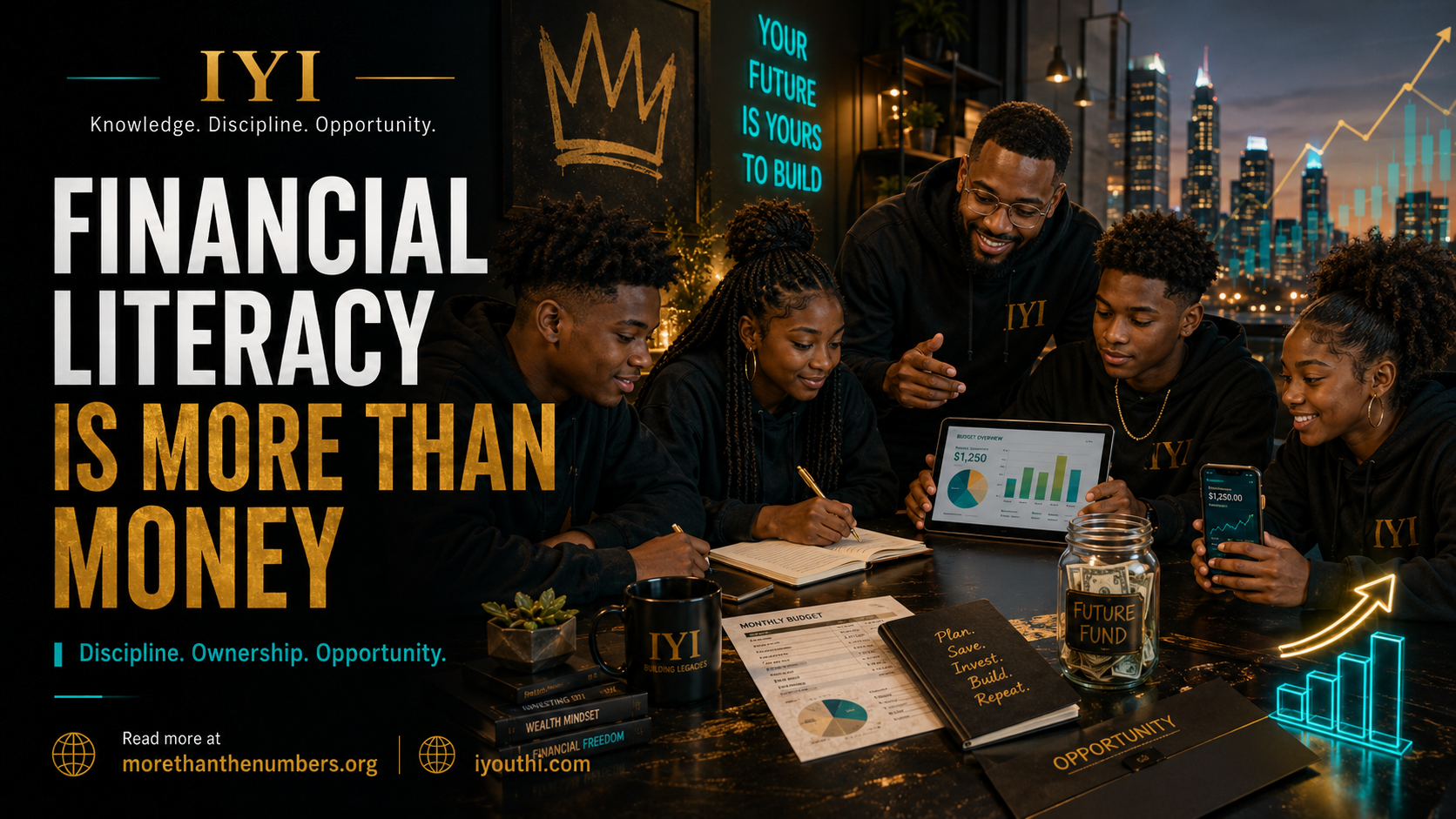
Financial literacy is more than money.
It is more than learning how to save.
It is more than learning how to budget.
It is more than knowing the difference between income and expenses.
For Black urban teens, financial literacy can become something much deeper.
It can become a doorway to confidence.
A doorway to discipline.
A doorway to ownership.
A doorway to better decisions.
A doorway to opportunity.
At International Youth Initiative, we believe financial literacy is one of the most important tools young people can be exposed to early. Not because money solves every problem, but because understanding money helps young people understand choices, systems, responsibility, and power.
Many youth grow up seeing financial stress before they ever receive financial education.
They may hear conversations about bills.
They may see adults working hard but still struggling.
They may experience pressure around food, transportation, housing, clothes, school costs, or family responsibilities.
But too often, nobody breaks down how money actually works.
That gap matters.
Financial literacy is still not guaranteed everywhere
Across the country, financial education is improving, but access is still uneven. The Council for Economic Education reported in 2026 that 39 states require a personal finance course for high school graduation, showing major progress — but also showing that personal finance education still depends heavily on where a young person lives and what their school system provides.
That matters because financial literacy should not be treated like extra knowledge.
It is life knowledge.
A young person may graduate knowing many things, but still not understand credit, debt, interest, taxes, budgeting, banking, investing, insurance, income, or how to avoid financial traps.
When that happens, young people enter adulthood without a full picture of how money decisions affect their future.
The job gap makes financial education even more important
Financial literacy becomes even more important when young people are already facing barriers to work and income.
According to Bureau of Labor Statistics quarterly data, in the first quarter of 2026, the unemployment rate for Black youth ages 16 to 19 was 19.5%, compared with 14.0% for all youth ages 16 to 19 and 12.6% for White youth in that same age group.
That gap is not just about jobs.
It is about access to early work experience.
It is about confidence.
It is about learning responsibility.
It is about building a résumé.
It is about understanding income.
It is about seeing how effort connects to opportunity.
When young people have fewer chances to earn, learn, and build work habits, financial literacy becomes even more necessary. It gives them a foundation before the opportunity arrives.
Some teens are disconnected from both school and work
The Annie E. Casey Foundation’s 2025 KIDS COUNT Data Book reported that Black teens ages 16 to 19 had a 9% rate of being neither in school nor working, compared with 6% for White teens and 3% for Asian and Pacific Islander teens. The same report explains that teens who are not connected to school or work face serious barriers entering adulthood.
That is why early exposure matters.
The goal should not be to wait until a young person is already disconnected.
The goal should be to reach them early with tools, direction, mentorship, and practical education that connects to real life.
Financial literacy can help create that connection.
It can show a young person why school matters.
It can show why discipline matters.
It can show why income matters.
It can show why choices today affect options tomorrow.
Financial pressure is real in many households
Financial pressure does not only affect adults. Young people often feel it too.
The Federal Reserve’s report on the economic well-being of U.S. households found that in 2023, 63% of adults said they could cover a hypothetical $400 emergency expense using only cash or its equivalent. That also means a significant share of adults would need to borrow, sell something, or could not cover the expense. The same report found that 54% of adults had emergency savings equal to three months of expenses.
For young people growing up around financial pressure, money can become something associated with stress instead of strategy.
That is why the message has to change.
Money should not only be explained when there is a crisis.
Money should be taught before the crisis.
Banking and access still matter
Financial inclusion is also part of financial literacy.
The FDIC’s 2023 National Survey of Unbanked and Underbanked Households found that 14.2% of U.S. households were underbanked in 2023, meaning they had a bank or credit union account but still primarily used nonbank financial products and services to meet financial needs.
The FDIC also reported that although unbanked rates for Black, Hispanic, and American Indian or Alaska Native households fell by about half between 2009 and 2023, those groups’ unbanked rates remained several times higher than the White household rate in 2023.
This matters because financial literacy is not just about telling young people to save.
It is also about helping them understand the tools around money.
Bank accounts.
Credit unions.
Debit cards.
Credit cards.
Interest.
Fees.
Loans.
Predatory products.
Digital payments.
Taxes.
Investing.
Insurance.
These systems can either help people build or keep people stuck, depending on whether they understand how they work.
Financial literacy is decision-making
At IYI, we believe financial literacy should be taught as decision-making.
A budget is not just a spreadsheet.
It is a plan.
Saving is not just holding money.
It is discipline.
Credit is not just a score.
It is access.
Investing is not just about markets.
It is long-term thinking.
Entrepreneurship is not just about making money.
It is ownership, problem-solving, and creating value.
When young people learn these ideas early, they begin to think differently about their choices.
They may start asking:
Where is my money going?
What am I building?
What do I need to learn?
How can I create income?
What habits are helping me?
What habits are hurting me?
What future am I preparing for?
Those questions matter.
Why this matters for Black urban teens
Black urban teens do not need to be defined by statistics.
They need access to tools that help them move beyond the statistics.
They need financial education that speaks to real life. Not just textbook examples, but conversations about the pressures, choices, and opportunities they actually see.
They need to learn how money connects to housing, transportation, business, education, credit, technology, ownership, markets, and family stability.
They need to understand that financial literacy is not about pretending life is easy.
It is about learning how to move smarter inside a world that can be complicated.
That is where IYI comes in.
The IYI approach
International Youth Initiative is focused on helping youth build real-world understanding through financial literacy, entrepreneurship, technology, AI, market education, leadership, mentorship, and self-reliance.
For us, financial literacy is not a stand-alone topic.
It connects to everything.
It connects to entrepreneurship because young people need to understand income, cost, value, and profit.
It connects to technology because the future economy is digital.
It connects to AI because young people need to know how new tools can help them learn, create, and compete.
It connects to market education because markets teach patience, discipline, risk management, global awareness, and strategy.
It connects to leadership because disciplined decision-making shapes how people lead themselves and others.
That is why financial literacy matters.
Not because every young person will become an investor.
Not because every young person will start a business.
Not because money is the only measure of success.
But because every young person will make financial decisions.
And those decisions can shape the direction of their life.
From money stress to money strategy
The goal is not just to teach youth how to count money.
The goal is to help them think strategically.
To move from stress to structure.
From reaction to planning.
From spending without direction to decision-making with purpose.
From limited exposure to real opportunity.
Financial literacy can give young people language for choices they were already facing.
It can help them understand that money is not just something that happens to them.
It is something they can learn to manage, protect, build, and use with intention.
That is a powerful shift.
Because when youth understand money better, they can begin to understand opportunity better.
And when they understand opportunity better, they can begin to build differently.