
Negative youth statistics do not have to become permanent outcomes.
Behind every number is a young person.
Behind every young person is a story.
Behind every story is potential that still deserves to be protected, developed, and invested in.
Too often, Black urban teens are talked about through negative numbers connected to violence, unemployment, school disconnection, mental health, poverty, and lack of opportunity.
Those numbers are real.
But they are not the whole story.
At International Youth Initiative, we believe statistics should not be used to label young people. They should be used to show where support is needed most.
The goal is not just to talk about the numbers.
The goal is to help change them.
The numbers show the pressure
Many young people are carrying pressure that adults may not always see.
Some are dealing with trauma.
Some are dealing with grief.
Some are dealing with stress at home.
Some are trying to survive unsafe environments.
Some are disconnected from school, work, mentorship, or opportunity.
When that pressure is not supported, it can show up in the statistics.
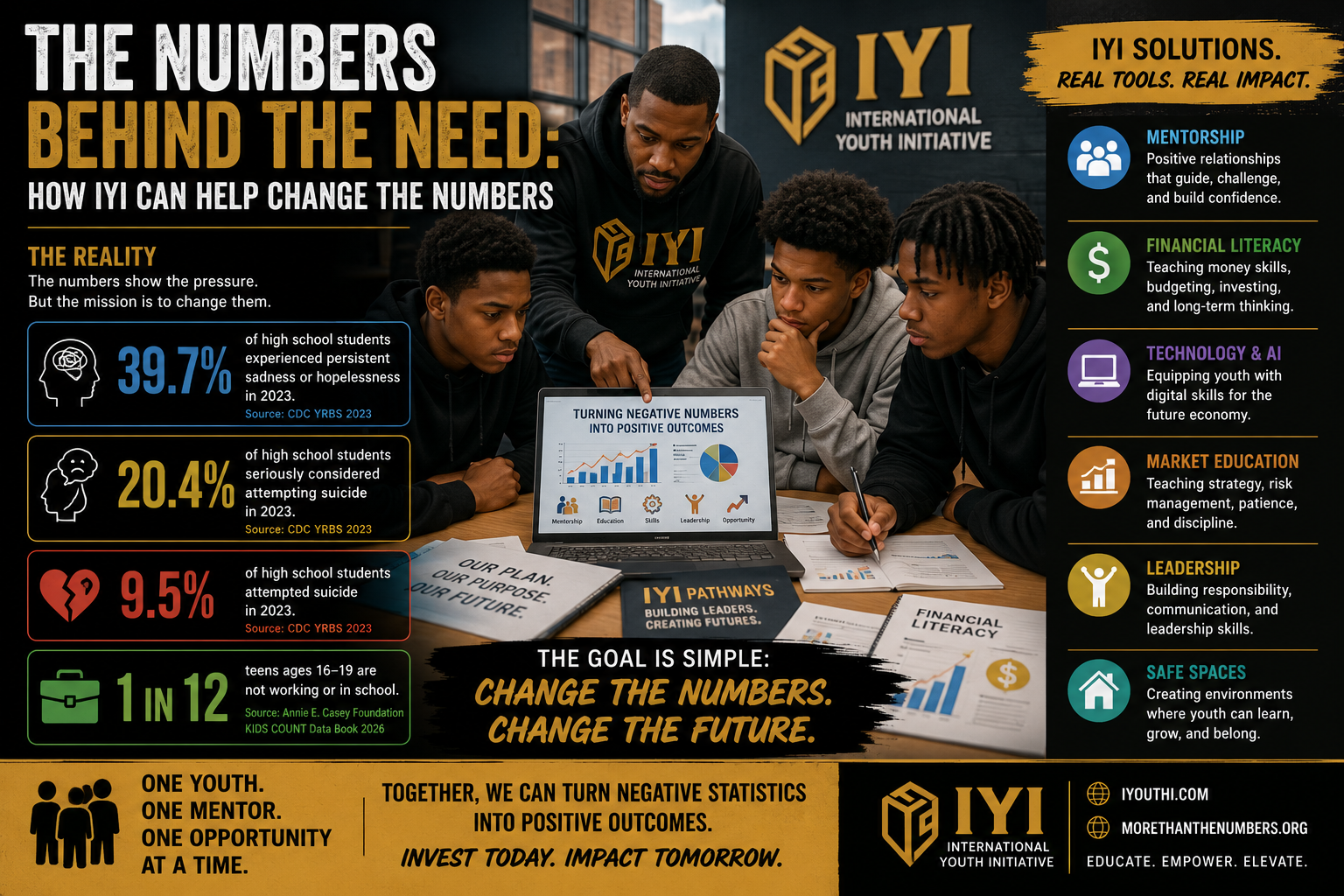
The CDC reported that in 2023, 39.7% of high school students experienced persistent sadness or hopelessness, 20.4% seriously considered attempting suicide, and 9.5% attempted suicide.
The Annie E. Casey Foundation reported that about 1 in 12 teens ages 16 to 19 are not working or in school.
These numbers show more than problems.
They show the need for prevention, connection, mentorship, safe spaces, and real opportunity.
Negative numbers need real solutions
A negative statistic is not just a data point.
It is a warning sign.
It tells us something is missing.
Maybe a young person needs a mentor.
Maybe they need a safe place to go.
Maybe they need financial education.
Maybe they need career exposure.
Maybe they need technology skills.
Maybe they need leadership development.
Maybe they need someone to help them see a future bigger than survival.
That is where IYI fits in.
IYI is built around the belief that young people need more than motivation. They need tools. They need structure. They need exposure. They need adults who show up consistently.
Mentorship can change direction
Mentorship can help interrupt negative outcomes before they become permanent.
A mentor can listen before a young person shuts down.
A mentor can guide before a bad decision is made.
A mentor can challenge before potential gets wasted.
A mentor can remind a young person that their future still matters.
Many youth do not need to be judged.
They need to be reached.
At IYI, mentorship is not just encouragement. It is connection, accountability, guidance, and belief.
That kind of support can help a young person move differently.
Financial literacy can change decision-making
Money pressure is real in many urban communities.
When young people are not taught about budgeting, saving, credit, debt, investing, ownership, or long-term planning, they may be more vulnerable to quick-money thinking and short-term decisions.
Financial literacy gives youth language.
It helps them understand choices.
It helps them think long term.
It helps them respect discipline.
It helps them see money as something to manage with purpose.
At IYI, financial literacy is not just about dollars.
It is about decision-making.
Technology and AI can open new doors
The future economy is moving fast.
Young people need exposure to technology, AI, digital tools, and future career pathways. If they are not introduced to these tools early, they can be left behind before they even get started.
IYI wants youth to be more than consumers of technology.
We want them to become users, builders, creators, and thinkers.
Technology can help youth learn faster.
AI can help youth explore ideas.
Digital skills can help youth compete.
Creative tools can help youth build projects, businesses, and new pathways.
Exposure can change what a young person believes is possible.
Market education can teach strategy
Stock market, options market, and currency market education are bigger than charts.
They teach patience.
They teach risk management.
They teach emotional control.
They teach research.
They teach timing.
They teach discipline.
Those lessons can carry into life.
A young person who learns to study before moving can apply that same lesson to real decisions. A young person who learns to manage risk can begin thinking differently about choices, conflict, money, and opportunity.
Market education helps move youth from reaction to strategy.
Safe spaces can create stability
Young people need places where they can breathe, learn, ask questions, and grow without being judged.
A safe space gives youth structure.
It gives them somewhere to go.
It gives them something to do.
It gives them people to learn from.
It gives them a place where purpose can grow.
IYI’s vision is to help create spaces where young people are not just kept busy — they are being built.
Built with knowledge.
Built with discipline.
Built with mentorship.
Built with leadership.
Built with opportunity.
The mission is to change outcomes
The numbers behind the need are serious.
But the answer cannot be hopelessness.
The answer has to be investment.
Invest in youth early.
Invest in mentorship.
Invest in safe spaces.
Invest in financial literacy.
Invest in technology and AI.
Invest in leadership.
Invest in real pathways.
When young people receive the right support, negative statistics do not have to define their future.
A disconnected youth can reconnect.
A struggling student can find direction.
A teen under pressure can find purpose.
A young person surrounded by risk can be exposed to opportunity.
That is the mission.
IYI exists because the numbers are real.
But so is the potential.
The goal is to help turn negative statistics into positive outcomes — one young person, one mentor, one lesson, one opportunity at a time.