
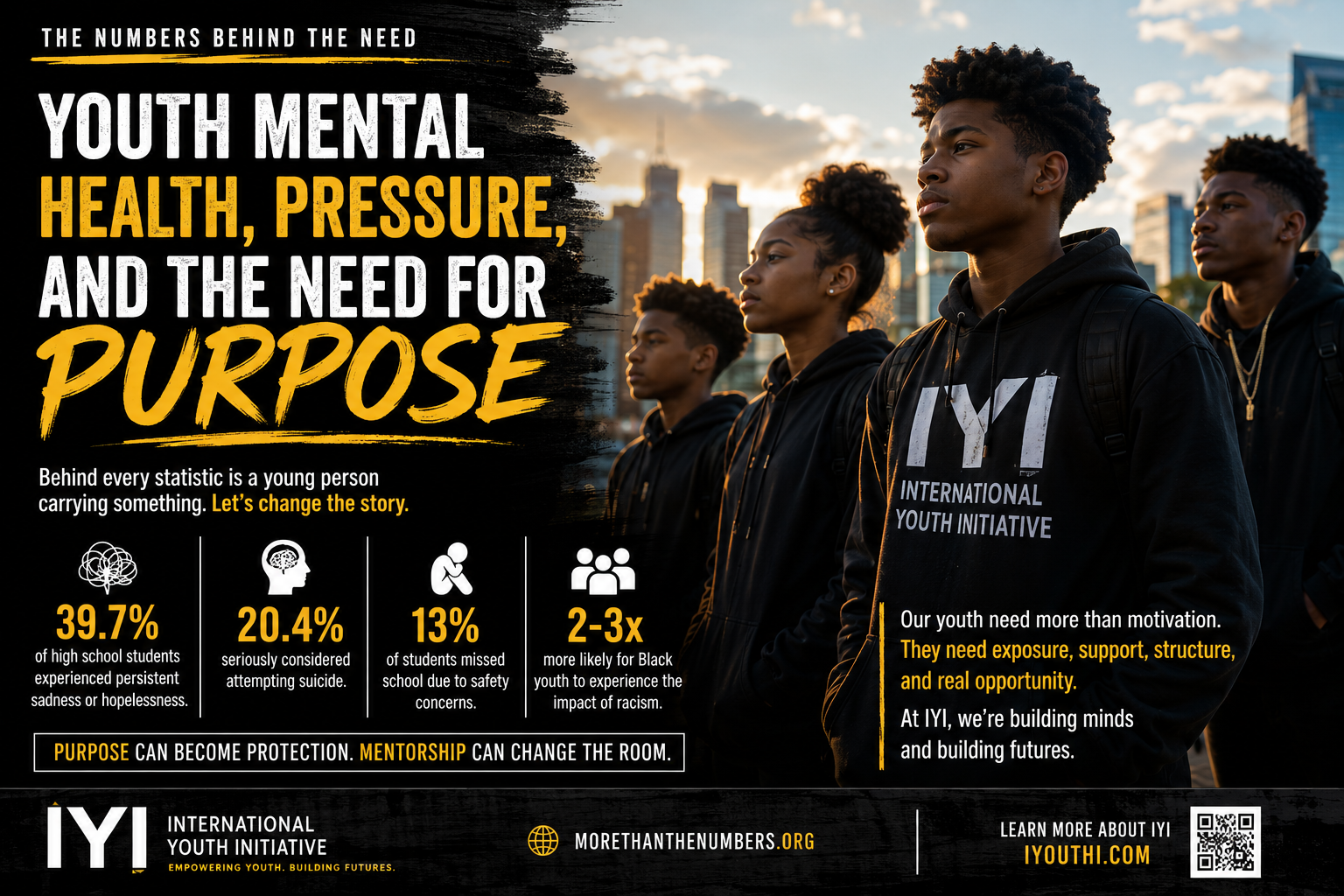
Behind every statistic is a young person carrying something.
Sometimes it is pressure.
Sometimes it is grief.
Sometimes it is fear.
Sometimes it is responsibility that came too early.
Sometimes it is silence.
Youth mental health is not just a personal issue. It is also a community issue, a school issue, a safety issue, and an opportunity issue. For many Black urban teens, the pressure they carry is connected to more than one part of life.
At International Youth Initiative, we believe the numbers matter because they show where the need is. But the numbers are not the whole story. The full story is the young person behind the data — the one trying to stay focused, stay safe, and still believe in a future.
The pressure is real
The CDC’s 2023 Youth Risk Behavior Survey reported that about 4 in 10 high school students experienced persistent feelings of sadness or hopelessness, and about 2 in 10 seriously considered attempting suicide.
Another CDC report found that 39.7% of high school students experienced persistent sadness or hopelessness, 28.5% experienced poor mental health, 20.4% seriously considered attempting suicide, and 9.5% attempted suicide.
Those numbers are heavy.
They represent students sitting in classrooms while carrying stress no one can see. They represent young people walking through neighborhoods while trying to act strong. They represent youth who may be smiling on the outside while struggling inside.
That is why youth mental health has to be taken seriously.
Safety affects learning
Mental health does not exist in isolation. Environment matters.
The CDC reported that students missing school because of safety concerns increased from 9% in 2021 to 13% in 2023.
That matters because a young person who does not feel safe may struggle to learn. A young person worried about what could happen at school, after school, or on the way home may not have the same mental space to focus, plan, or dream.
Safety affects attendance.
Attendance affects learning.
Learning affects confidence.
Confidence affects direction.
That is why youth development cannot only focus on academics. It also has to address the pressure surrounding young people’s lives.
Racism and unfair treatment add weight
Black youth and other youth of color often carry pressures that are not always recognized.
The CDC reported that students who experienced racism had higher rates of poor mental health, suicide risk, and substance use. The same CDC summary said experiences of racism were 2 to 3 times more prevalent among students from marginalized racial and ethnic groups compared with White students.
This matters because mental health is not only about what is happening inside a young person. It is also about what is happening around them.
If a student feels judged, overlooked, disciplined unfairly, or treated differently because of race, that can affect how they see school, adults, authority, and themselves.
At IYI, we believe youth need spaces where they are not treated like problems to manage. They need spaces where they are treated like minds to develop.
Milwaukee youth are more than the struggle
Milwaukee’s Black youth should never be reduced to crisis language alone.
The Black Youth Achievement in Milwaukee report described serious challenges, including young people facing financial responsibilities early, neighborhood violence, poverty, homelessness, and racism. But the report also emphasized that the resilience of Milwaukee’s Black youth is not always measured or highlighted properly.
That balance matters.
If we only talk about the pain, we miss the strength.
If we only talk about the statistics, we miss the young person.
If we only talk about what is wrong, we miss what can be built.
More Than The Numbers exists because our youth are more than data points. They are thinkers, builders, future leaders, and young people who need exposure, support, mentorship, discipline, and real opportunity.
Purpose can become protection
Purpose does not erase pain.
But purpose can give a young person something to hold onto.
When youth have purpose, they have a reason to look forward. They have something to build toward. They have a reason to keep learning, keep showing up, and keep developing.
Purpose can come through mentorship.
Purpose can come through financial literacy.
Purpose can come through entrepreneurship.
Purpose can come through technology and AI.
Purpose can come through market education.
Purpose can come through leadership and community.
At IYI, purpose is not just a motivational word. It is a practical need.
A young person needs to know why their choices matter.
They need to know why discipline matters.
They need to know why their mind matters.
They need to know why their future is worth protecting.
Mentorship changes the room
Many young people do not need someone to talk down to them.
They need someone to sit with them.
Someone to listen.
Someone to challenge them.
Someone to explain things clearly.
Someone to expose them to new ideas.
Someone to help them see what is possible.
Mentorship can help turn pressure into direction.
A mentor can help a young person slow down before reacting, think before moving, and see discipline as preparation — not punishment.
That kind of guidance matters.
The IYI solution
At IYI, we are not just trying to inspire youth for a moment.
We want to build spaces where youth can learn, question, think, and grow.
Financial literacy teaches decision-making.
Entrepreneurship teaches ownership.
Technology and AI teach adaptability.
Market education teaches patience, risk management, and global awareness.
Leadership teaches responsibility and service.
Mentorship reminds young people they do not have to figure everything out alone.
These are not random topics.
They are tools for purpose.
They help youth move from pressure to planning.
From reaction to reflection.
From survival thinking to strategy thinking.
From feeling unseen to understanding their value.
Mental health awareness matters, but awareness alone is not enough.
Young people need support.
They need safe spaces.
They need opportunity.
They need structure.
They need adults who are consistent.
They need programs that speak to their real lives.
Because behind every mental health statistic is a young person.
A young person who may need someone to notice.
A young person who may need a mentor.
A young person who may need a different environment.
A young person who may need a reason to believe tomorrow can be different.
At IYI, we believe that reason can be built.
One conversation.
One lesson.
One mentor.
One opportunity.
One young person at a time.