
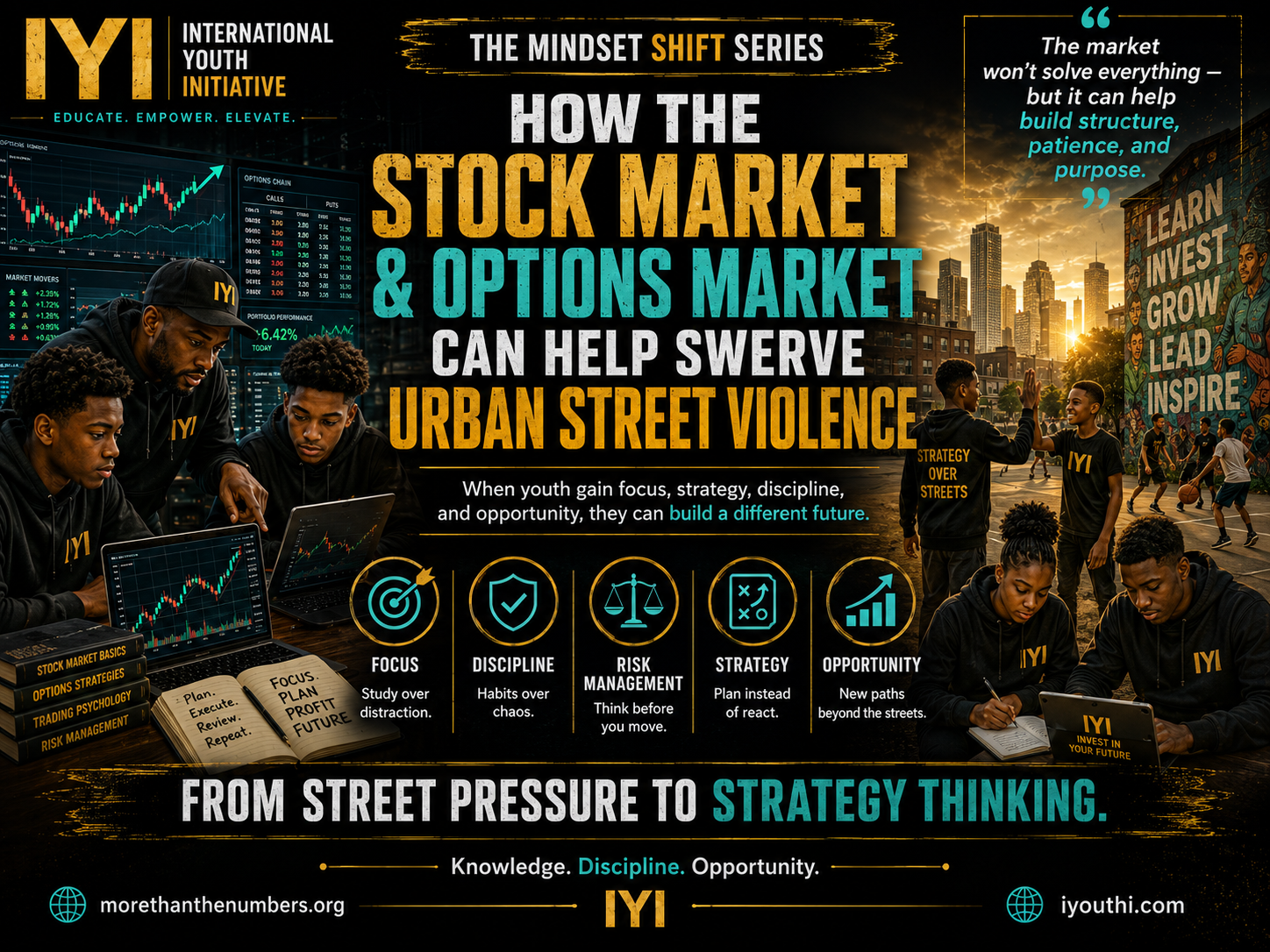
Street violence does not come from nowhere.
It often grows from pressure — poverty, trauma, anger, limited options, and the feeling that there is no better path. Too many young people are forced to react before they are ever taught how to plan.
At International Youth Initiative, we believe youth need more than warnings. They need alternatives. They need exposure. They need real tools that can help them think differently.
That is where stock market and options market education can play a role.
The market will not solve violence by itself. It does not replace mentors, family, mental health support, jobs, safe spaces, or community investment. But it can introduce something powerful: structure.
Market education teaches young people to slow down, study, wait, plan, and understand risk before making a move.
Those lessons are bigger than trading.
A stock chart can teach focus.
An options contract can teach risk.
A trading plan can teach discipline.
A loss can teach review.
Waiting for the right setup can teach patience.
In the streets, reacting too fast can change a life. In the markets, reacting too fast can cost money. Both teach an important truth: decisions have consequences.
At IYI, we do not teach markets as gambling or quick money. We teach them as a mindset tool. The goal is not to chase fast profits. The goal is to build focus, discipline, patience, and strategy.
For urban youth carrying pressure, those lessons matter.
Instead of being pulled into conflict, they can be pulled into learning.
Instead of chasing street status, they can chase knowledge.
Instead of moving off emotion, they can learn to move with a plan.
That is the mindset shift.
The stock market helps youth understand companies, ownership, money movement, and long-term thinking. The options market helps teach timing, probability, discipline, and risk management. Together, they can expose young people to a world bigger than survival.
But mentorship is key.
Young people need guidance to understand the difference between investing, trading, and gambling. They need mentors who can teach emotional control, patience, and responsibility. They need someone to help connect the lesson on the screen to the decisions they face in real life.
This is bigger than charts.
When a young person learns to study instead of react, that is growth.
When they learn to wait instead of chase, that is discipline.
When they learn to manage risk, that is wisdom.
When they learn to think ahead, that is leadership.
Street violence is serious. But our youth are not the problem.
Lack of exposure is part of the problem.
Lack of opportunity is part of the problem.
Lack of mentorship is part of the problem.
Lack of purpose is part of the problem.
That means the solution has to include exposure, opportunity, mentorship, structure, and purpose.
At IYI, we believe market education can be one piece of that solution.
One lesson.
One mentor.
One chart.
One conversation.
One young person choosing strategy over the streets.
That is how futures begin to change.