
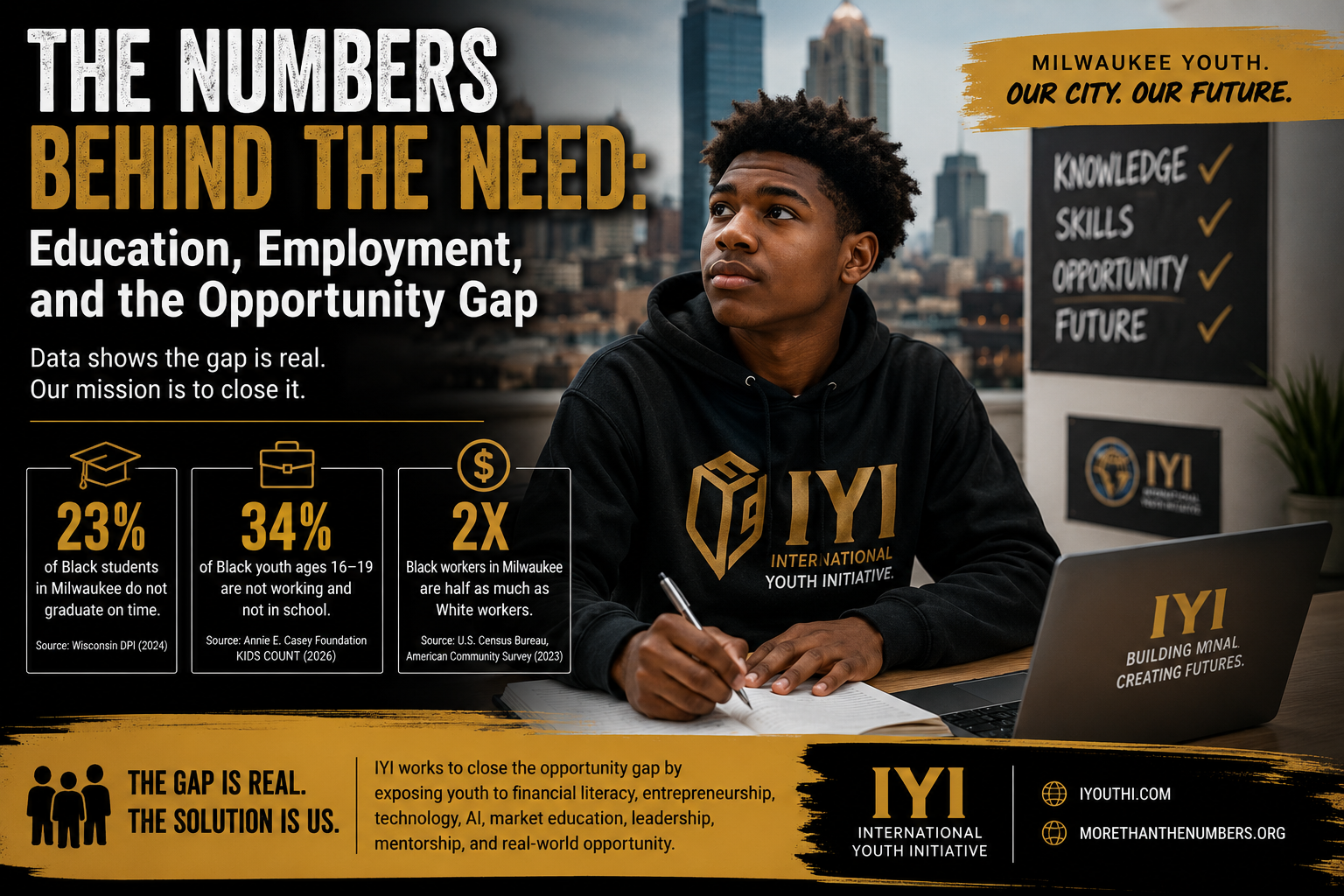
Behind every statistic is a young person trying to find direction.
A young person trying to stay focused in school.
A young person trying to get a first job.
A young person trying to figure out what comes next.
A young person who may have talent, but not enough access to opportunity.
Education and employment are connected.
When young people are supported in school, they have a stronger chance of building confidence, skills, and direction. When they are connected to work, they learn responsibility, communication, time management, and problem-solving. But when school and work opportunities are limited, young people can become disconnected from the future they deserve.
At International Youth Initiative, we believe the opportunity gap is not only about what youth lack. It is also about what they have not been exposed to yet.
Education is still a major part of opportunity
Education is not the only path to success, but it is still a major doorway to options.
The National Center for Education Statistics reported that in 2021–22, the U.S. average adjusted cohort graduation rate for Black public high school students was 81%, which was 9 percentage points lower than the national average for all public high school students.
That number matters.
A diploma is not just a piece of paper. It can affect job access, career options, confidence, training opportunities, and future income. When graduation gaps exist, opportunity gaps often follow.
But the answer cannot be only telling young people to “do better.”
The answer has to include support, mentorship, relevant learning, real-world exposure, and spaces where youth understand why education connects to life.
Young people need to see the purpose behind learning.
They need to understand how reading connects to business.
How math connects to money.
How writing connects to communication.
How technology connects to the future.
How discipline connects to opportunity.
That is where IYI’s work fits.
Employment gaps affect early direction
A first job can teach more than how to earn a paycheck.
It can teach a young person how to show up on time, communicate with adults, follow instructions, solve problems, work with a team, and build confidence. Work experience can help youth see themselves as capable and responsible.
But access to early work is not equal.
Federal Reserve Economic Data, using Bureau of Labor Statistics data, showed the unemployment rate for Black or African American youth ages 16 to 19 was 23.9% in May 2026.
That means too many young Black teens are trying to enter the workforce but facing barriers.
And when young people cannot access work, the issue is bigger than income. It can affect identity, confidence, structure, and direction.
Work gives youth a chance to practice responsibility.
Work gives youth a chance to learn people skills.
Work gives youth a chance to build a résumé.
Work gives youth a chance to connect effort with progress.
When that chance is missing, mentorship and skill-building become even more important.
Some teens are disconnected from both school and work
The Annie E. Casey Foundation’s 2025 KIDS COUNT Data Book reported that Black teens ages 16 to 19 had a 9% rate of being neither in school nor working, compared with 6% for White teens and 3% for Asian and Pacific Islander teens.
That is one of the clearest signs of the opportunity gap.
When a young person is not connected to school or work, they may also be disconnected from structure, mentorship, daily purpose, and future planning.
That does not mean they lack value.
It means they need connection.
They need a reason to believe learning matters.
They need a pathway that feels real.
They need adults who can help them see options.
They need opportunities that connect education to life.
At IYI, we believe early exposure can help prevent disconnection before it becomes a deeper problem.
Safety and school experience matter too
Education is not only about classrooms and grades. It is also about whether students feel safe, respected, and supported.
The CDC’s 2023 Youth Risk Behavior Survey reported that students missing school because of safety concerns increased from 9% in 2021 to 13% in 2023. The same CDC summary also highlighted findings about racism, unfair discipline, and the impact these experiences can have on students’ mental health.
A young person who feels unsafe may struggle to focus.
A young person who feels unfairly treated may start to disconnect.
A young person who does not feel seen may stop believing that school is connected to their future.
That is why education reform and youth development must include belonging, safety, fairness, and purpose.
Milwaukee’s story needs more than negative labels
Milwaukee’s Black youth should not be reduced to struggle alone.
The Black Youth Achievement in Milwaukee report explains that Milwaukee’s history of segregation, redlining, and systemic disinvestment has contributed to inequities in health, education, and employment outcomes for neighborhoods with large Black populations. But the report also emphasizes Black youth achievement, resilience, lived experience, and the importance of building from community strengths.
That balance matters.
If we only talk about the gap, we miss the greatness.
If we only talk about the numbers, we miss the young person.
If we only talk about what is wrong, we miss what can be built.
More Than The Numbers exists because the data should point us toward action — not hopelessness.
The opportunity gap is also an exposure gap
Many young people are not lacking intelligence.
They are lacking access.
Access to mentors.
Access to career conversations.
Access to financial literacy.
Access to entrepreneurship.
Access to technology and AI.
Access to market education.
Access to leadership development.
Access to people who can show them what is possible.
That is why exposure matters.
A young person cannot prepare for a path they have never seen. They cannot pursue a future they have never been invited to imagine.
When youth are exposed to real-world learning, they begin to ask different questions.
How does money work?
How do businesses start?
How does technology create opportunity?
What skills will the future economy require?
How do markets move?
How can I build something of my own?
What habits do I need now for the future I want later?
Those questions can shift mindset.
The IYI solution
At International Youth Initiative, we believe youth need more than motivation.
They need tools.
Financial literacy teaches decision-making.
Entrepreneurship teaches ownership.
Technology and AI teach adaptability.
Market education teaches patience, risk, focus, and global awareness.
Leadership teaches responsibility and service.
Mentorship helps youth understand they do not have to figure everything out alone.
These are practical tools for closing the opportunity gap.
Not overnight.
Not with empty promises.
But one lesson, one mentor, one skill, and one opportunity at a time.
From gap to pathway
The goal is not just to talk about education and employment gaps.
The goal is to build pathways.
Pathways from school to skill.
Pathways from skill to confidence.
Pathways from confidence to opportunity.
Pathways from opportunity to leadership.
Pathways from leadership to legacy.
When youth are connected to education, work, mentorship, and real-world learning, they begin to see themselves differently.
They begin to move with more purpose.
They begin to understand their decisions matter.
They begin to see that their future is worth preparing for.
The numbers show us where the need is.
But the mission shows us what can be built.
At IYI, we believe our youth are more than statistics. They are future workers, creators, entrepreneurs, technologists, investors, leaders, and builders.
They do not just need to be counted.
They need to be invested in.