
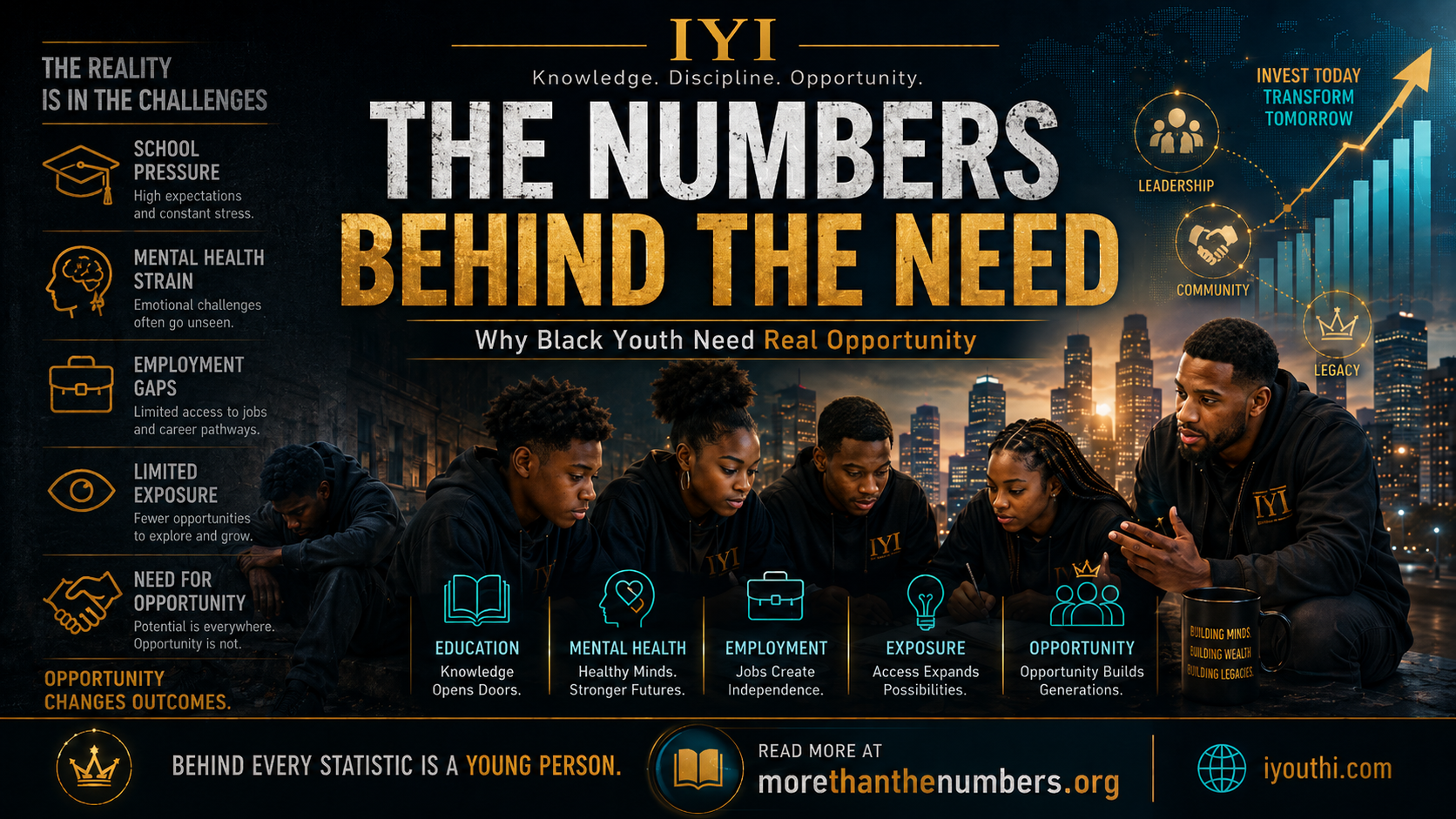
Behind every statistic is a young person.
A young person trying to figure out school.
A young person trying to stay safe.
A young person trying to manage pressure.
A young person trying to see a future beyond what is directly in front of them.
At International Youth Initiative, we believe the numbers matter — but the numbers are not the whole story.
The numbers point to the need.
The youth point to the future.
That is why IYI is focused on real opportunity: financial literacy, entrepreneurship, technology, market education, leadership, mentorship, and self-reliance.
The situation facing Black youth, especially in urban communities, cannot be reduced to one issue. It is not only about school. It is not only about jobs. It is not only about violence. It is not only about money. It is the combination of many pressures happening at once.
And when those pressures stack up, young people need more than speeches.
They need structure.
They need exposure.
They need practical tools.
They need people willing to build with them.
The pressure is real
National youth data continues to show serious concerns around mental health, safety, and school experience. The CDC’s 2023 Youth Risk Behavior Survey reported that 40% of high school students experienced persistent feelings of sadness or hopelessness, even though that number improved slightly from 42% in 2021. The same CDC summary also reported that students missing school because of safety concerns increased from 9% in 2021 to 13% in 2023.
Those numbers are not just health statistics. They are warning signs.
A young person who feels unsafe may struggle to focus.
A young person carrying emotional pressure may struggle to plan.
A young person who feels disconnected may stop believing that opportunity is real.
That is why mental health, purpose, and opportunity are connected.
Black students are also facing unique school pressures
The CDC also found that experiences of racism were 2 to 3 times more prevalent among students from marginalized racial and ethnic groups compared to White students. The same report says students who experienced racism had higher rates of poor mental health, suicide risk, and substance use. It also states that Black students were more likely than White and Hispanic students to report unfair discipline at school.
This matters because education is supposed to be a place where young people develop confidence, direction, and possibility.
But when a student feels unfairly judged, overlooked, or disciplined differently, it can affect how they see themselves and their future.
IYI’s approach is not to ignore those realities. Our approach is to respond with solutions.
We want to create spaces where youth can be seen differently — not as problems to manage, but as minds to develop.
Work and opportunity gaps are still part of the picture
Economic opportunity is another major issue.
According to the Bureau of Labor Statistics, in the first quarter of 2026, the unemployment rate for Black youth ages 16 to 19 was 19.5%, compared with 14.0% for all youth ages 16 to 19 and 12.6% for White youth in that same age group.
That gap matters.
When young people cannot access early work experience, mentorship, or skill-building opportunities, it can affect confidence and long-term direction. A first job is not just a paycheck. It can teach communication, time management, responsibility, discipline, and problem-solving.
But if access is uneven, then preparation has to be intentional.
That is why IYI focuses on more than traditional classroom learning. We believe youth need exposure to financial literacy, entrepreneurship, technology, AI, and market education because the future economy will require more than just basic survival skills.
Some teens are disconnected from both school and work
The Annie E. Casey Foundation’s 2025 KIDS COUNT Data Book reported that Black teens ages 16 to 19 had a 9% rate of being neither in school nor working, compared with 6% for White teens and 3% for Asian and Pacific Islander teens. The report explains that teens who are not in school or working face major barriers entering adulthood.
This is exactly why early intervention matters.
The goal should not be to wait until a young person is already disconnected. The goal should be to reach them earlier, expose them earlier, and give them a reason to believe that learning connects to life.
That is where programs like IYI can play an important role.
Milwaukee’s Black youth are more than the challenges
Milwaukee-specific research also shows why we need to be careful not to reduce Black youth to negative statistics. The Black Youth Achievement in Milwaukee report states that Milwaukee’s history of segregation, redlining, and disinvestment has contributed to inequities in health, education, and employment outcomes. But the same report emphasizes that Black youth achievement, resilience, and lived experience must be part of the story too.
That is important.
If we only talk about what is wrong, we miss what is strong.
The same Milwaukee report notes that participants in community data conversations described Black youth as resilient and emphasized that the data often does not fully capture that resilience. Participants also discussed challenges including financial responsibilities at young ages, neighborhood violence, poverty, homelessness, and racism.
That is the balance IYI wants to bring.
We are not ignoring the numbers.
We are not ignoring the pressure.
We are not ignoring the systems.
But we also refuse to ignore the potential.
The solution has to be practical
Young people do not need more empty talk. They need real-world learning.
They need to understand money.
They need to understand business.
They need to understand technology.
They need to understand leadership.
They need to understand how the world is changing.
That is why IYI’s work matters.
When we teach financial literacy, we are not just talking about saving money. We are teaching decision-making.
When we talk about entrepreneurship, we are not just talking about starting a business. We are teaching ownership, creativity, and problem-solving.
When we introduce AI and technology, we are not just talking about tools. We are helping youth prepare for the future economy.
When we introduce market education, we are not telling youth to chase quick money. We are teaching patience, discipline, risk management, global awareness, and strategy.
These lessons are bigger than numbers.
They help young people think differently.
From statistics to strategy
The numbers show us where the need is.
But strategy shows us how to respond.
If youth are facing mental pressure, they need purpose and support.
If youth are facing school challenges, they need spaces where they feel valued.
If youth are facing employment barriers, they need skill-building and exposure.
If youth are facing limited opportunity, they need access to new ideas.
At IYI, we believe the answer is not just to describe the problem.
The answer is to build.
Build minds.
Build discipline.
Build confidence.
Build opportunity.
Build pathways.
Because behind every statistic is a young person.
And behind every young person is a future that still deserves investment.