Trauma changes how people think.
It can create fear.
It can create stress.
It can create anger.
It can create survival habits that are hard to break.
In many urban communities, trauma is not rare. It can come from violence, loss, instability, poverty, broken trust, family pressure, or constantly feeling like you have to stay on alert.
That kind of pressure affects the mind.
At International Youth Initiative, we believe healing has to include more than just telling young people to “do better.” Healing also has to include new tools, new environments, and new ways of thinking.
That is where the currency market can help.
Not because the forex market is a magic answer.
Not because money alone heals pain.
But because learning the currency market can teach habits that push the mind in a different direction.
The currency market teaches focus
Trauma can make the mind feel scattered.
A person may always feel like they have to react.
Always stay ready.
Always expect the worst.
Always move fast.
But the currency market teaches something different.
It teaches observation.
It teaches patience.
It teaches waiting.
It teaches studying before reacting.
That matters.
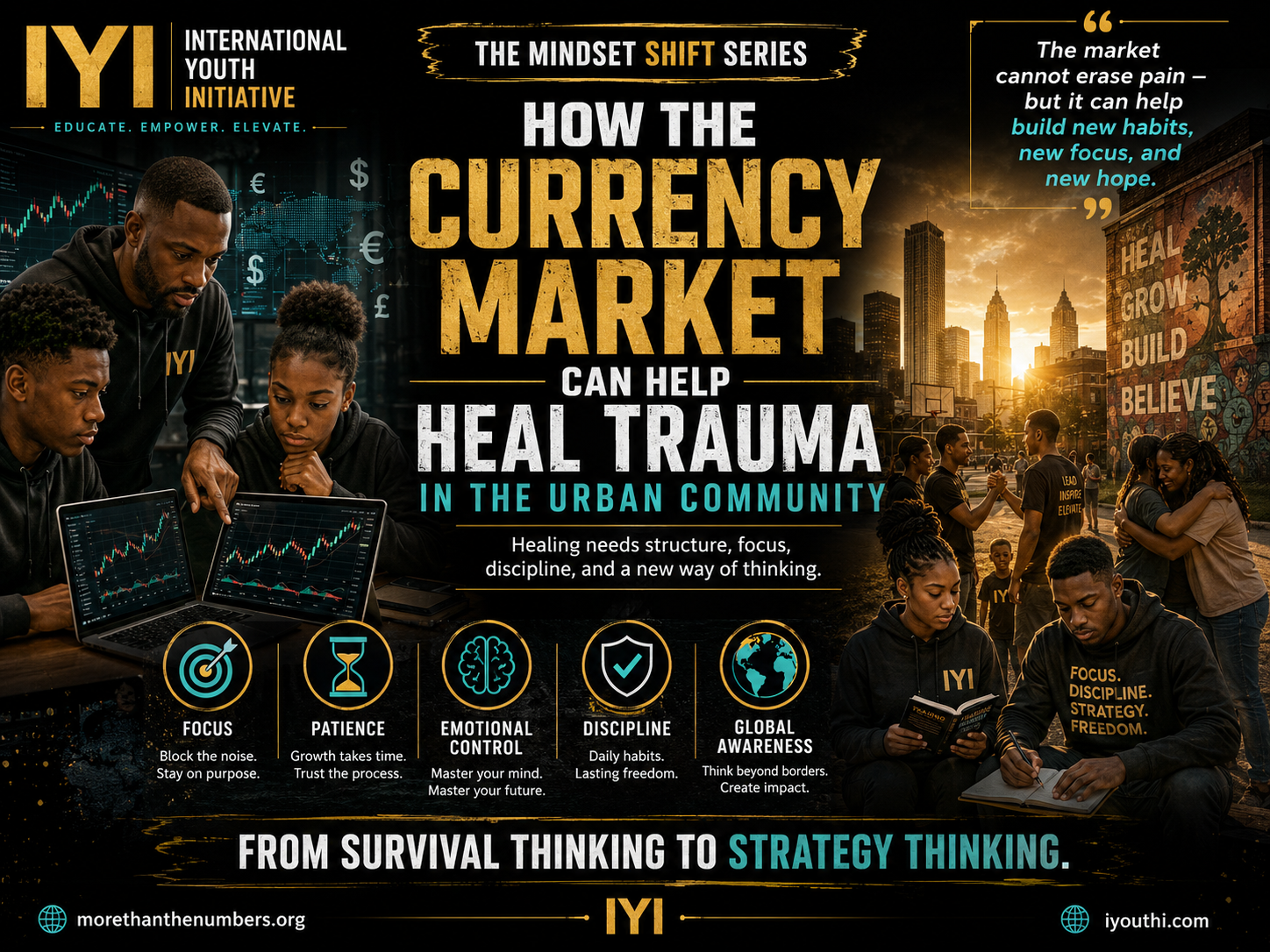
A young person who learns how to slow down and read a chart is also learning how to slow down mentally. They are learning that every move does not need an emotional reaction. They are learning that sometimes the best move is to wait, think, and prepare.
That is a powerful shift for someone who has lived in survival mode.
The currency market teaches discipline
Trauma can make life feel out of control.
That is why structure matters.
The forex market teaches routine. A person has to study, review, plan, manage risk, and stay disciplined. They learn quickly that emotion-based decisions often lead to poor results.
That lesson goes beyond trading.
Discipline can become part of healing because it gives a person something steady to build on.
When youth learn discipline, they begin to understand:
- every feeling does not need immediate action
- every opportunity is not the right opportunity
- preparation matters
- patience matters
- consistency matters
Those are life lessons.
The currency market teaches emotional control
One of the hardest effects of trauma is how it can shape reactions.
A person may become impulsive.
A person may shut down.
A person may act from fear, anger, or pressure.
The currency market forces people to confront that.
If someone trades based only on emotion, the market will expose it.
That can actually become a learning tool.
It teaches a person to recognize emotional triggers. It teaches them to step back, reset, and make decisions from a plan instead of from panic.
That does not replace therapy.
That does not replace mental health support.
But it can support the process by teaching emotional awareness and self-control.
The currency market gives the mind something constructive
Trauma often leaves empty space in a person’s thinking.
That space can get filled with fear, hopelessness, anger, or negative influence.
But when young people are introduced to something mentally engaging like the currency market, they begin using their mind differently.
They begin to study patterns.
They begin to ask questions.
They begin to think globally.
They begin to connect discipline with progress.
They begin to see that their mind can build something.
That matters in the urban community.
Many youth are surrounded by messages of limitation. The forex market introduces a very different message: the world is bigger than what you see around you.
A young person in Milwaukee can study London, Tokyo, New York, and global currencies. That kind of exposure can expand thinking.
It can remind them that their future is not trapped inside one zip code.
The currency market can create hope
Trauma often steals vision.
It makes tomorrow feel uncertain.
It makes the future feel blurry.
It can make young people focus only on getting through the day.
But learning the currency market can help rebuild hope because it introduces a skill connected to growth, discipline, and possibility.
It shows that the mind has value.
It shows that knowledge can open doors.
It shows that there are ways to build beyond survival.
At IYI, we do not teach markets as gambling or fantasy. We teach them as a tool for mindset, discipline, global awareness, and long-term thinking.
That is an important difference.
This is bigger than money
The real gift of learning the currency market is not just money.
It is mindset.
It is the ability to sit still long enough to think.
It is the ability to follow a plan.
It is the ability to study instead of react.
It is the ability to understand risk.
It is the ability to believe that a different future can be built.
For youth carrying trauma, those lessons can be part of transformation.
The market cannot erase what someone has been through.
But it can help them build new habits.
It can help them reclaim focus.
It can help them learn patience.
It can help them see the world differently.
It can help them start believing they can move differently too.
The IYI approach
At International Youth Initiative, we believe healing and opportunity should go together.
That is why we expose youth to:
- financial literacy
- entrepreneurship
- technology and AI
- market education
- leadership
- mentorship
These are not random topics.
They are tools that can help shift a person from survival thinking to strategy thinking.
For some youth, the currency market can become more than a financial lesson.
It can become a quiet space in the mind.
A place to focus.
A place to grow.
A place to turn pain into discipline.
A place to turn pressure into purpose.
That is why this matters.
Because healing in the urban community is not only about what we stop.
It is also about what we build.
And at IYI, we believe young people deserve tools that help them build stronger minds, stronger habits, and stronger futures.