
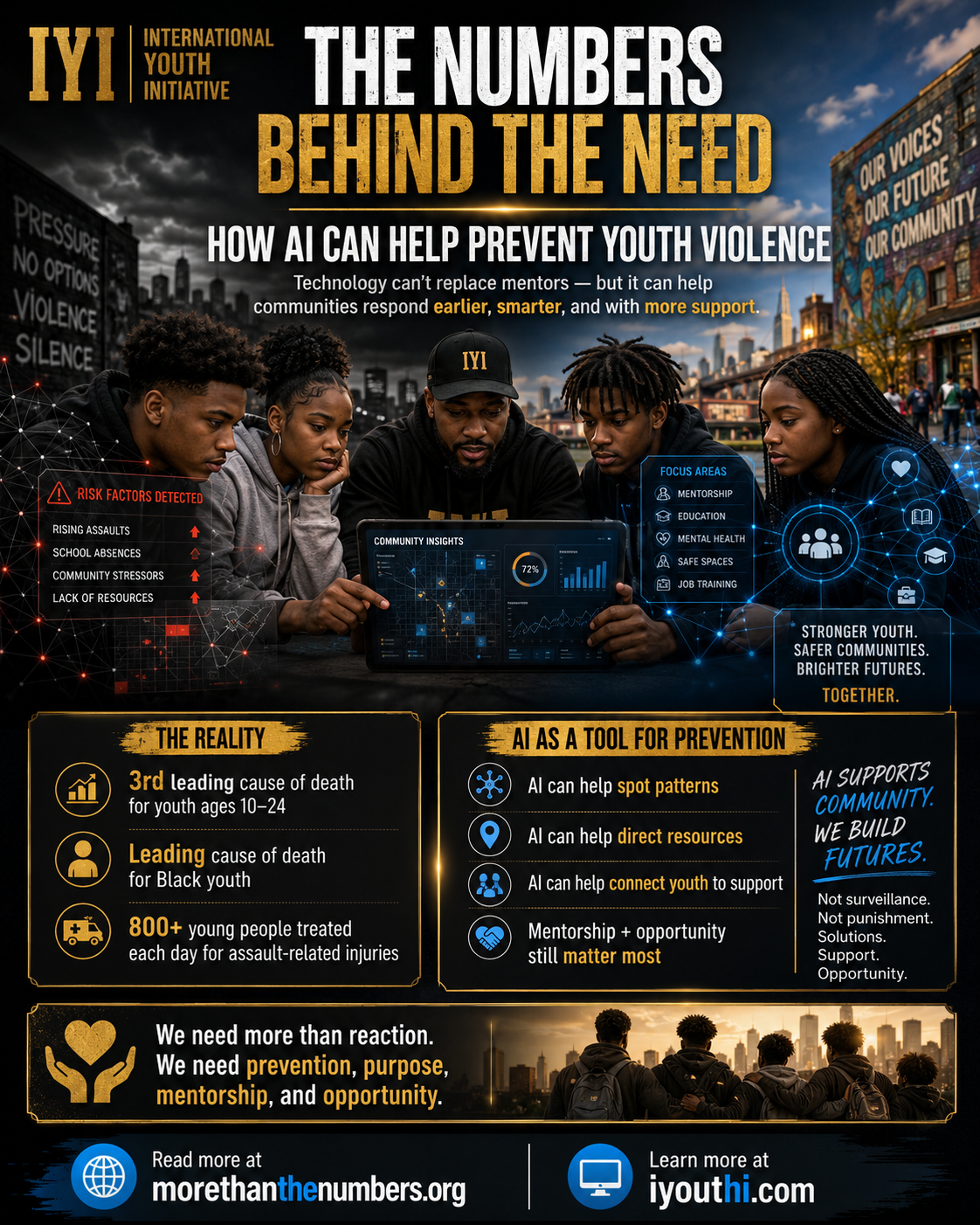
Behind every violence statistic is a young person, a family, and a community carrying the weight.
Youth violence is not just a crime issue. It is also a public health issue, a school issue, a mental health issue, and an opportunity issue. The CDC says homicide is the third leading cause of death for young people ages 10 to 24, and it is the leading cause of death for non-Hispanic Black or African American youth. The CDC also reports that emergency departments treat more than 800 young people each day for physical assault-related injuries.
Those numbers show why prevention has to start before the emergency.
At International Youth Initiative, we believe the solution has to be bigger than reaction. We cannot wait until a young person is already in crisis, already disconnected, or already caught in violence. We need ways to identify pressure earlier, connect youth to support earlier, and create pathways before the streets become the only option.
That is where AI can help.
AI cannot replace mentors.
AI cannot replace family.
AI cannot replace trust.
AI cannot replace community.
But AI can help communities see patterns faster and respond smarter.
AI can help organize data around school attendance, neighborhood needs, youth programming, transportation gaps, mental health resources, and areas where violence is increasing. It can help community organizations understand where support is needed most. It can help identify which neighborhoods need more mentoring, after-school programs, job training, financial literacy, or safe spaces.
In Milwaukee County, Wisconsin Watch reported that since 2023, 40 youth homicide victims were identified, and all but three died from gun violence. The report also noted that many were shot and killed by other teens. That is not just a statistic. That is a warning sign.
It means we need prevention earlier.
AI can help build early-warning systems that do not criminalize youth, but support them. There is a major difference between using technology to label young people and using technology to bring resources to where young people need help.
That difference matters.
The wrong use of AI can create harm. Some schools have used AI monitoring tools to scan student activity for threats, bullying, self-harm, or violence concerns, but investigations have raised serious concerns about privacy, student trust, and sensitive information being exposed. That means AI must be used carefully, ethically, and with community protection at the center.
AI should not be used to profile youth.
AI should be used to help protect youth.
It can help answer questions like:
Where are young people most disconnected from school or work?
Where are youth programs missing?
Where are transportation barriers keeping teens from opportunity?
Where are violence patterns increasing?
Where are mental health resources needed?
Where can mentors make the greatest impact?
Those questions can help turn data into action.
At IYI, we believe AI should be part of a larger solution. Not surveillance by itself. Not punishment by itself. Not technology without trust.
The real solution is AI plus mentorship.
AI plus opportunity.
AI plus financial literacy.
AI plus entrepreneurship.
AI plus mental health support.
AI plus safe spaces.
AI plus community leadership.
Technology can show us where the need is.
People still have to show up.
When AI is used the right way, it can help organizations make better decisions. It can help leaders see gaps. It can help communities act earlier. It can help connect youth to programs before they are lost to the streets, violence, or hopelessness.
But the heart of the work is still human.
A young person needs someone to notice.
Someone to listen.
Someone to guide them.
Someone to teach them.
Someone to believe they are more than a statistic.
That is why IYI’s mission matters.
We want to expose youth to financial literacy, entrepreneurship, technology, AI, market education, leadership, and mentorship — not as random topics, but as tools for direction.
Violence prevention is not only about stopping something bad.
It is about building something better.
Better options.
Better support.
Better exposure.
Better structure.
Better futures.
The numbers show the need.
AI can help us understand the patterns.
But community, mentorship, and opportunity are what help change the outcome.
At IYI, we believe technology should not be used to write youth off.
It should be used to help open doors.
One young person.
One mentor.
One opportunity.
One smarter solution at a time.